
Lee Heidhues 5.27.2023
It’s amazing that War Criminal Henry Kissinger has lived to be 100 without being summoned to the International Court for Criminal Justice in The Hague.

Why Kissinger continues to, and still does, receive such adulation in some parts of the mainstream media speaks volumes to his self promotion. It is also a stinging indictment of the American media and its subservience to Power.
Kissinger’s record of malevolence and slaughter is well documented. In the 1950’s he wrote a book about nuclear war.
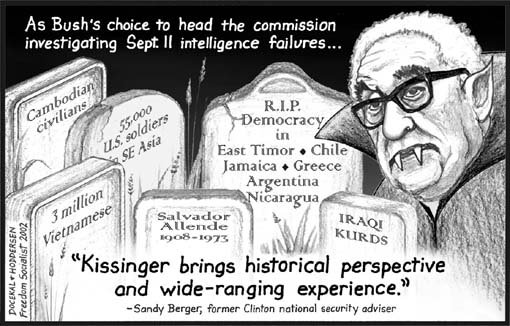
In 1969 he joined the Nixon Administration after telling the South Vietnamese government to not agree to a Peace Deal prior to the 1968 election. Promising the Saigon puppet regime it would get a better deal with Nixon.
Once in the White House Kissinger oversaw the secret bombing of Cambodia which drove out a neutral regime and, ultimately, led to the murderous Pol Pot dictatorship and slaughter of hundreds of thousands of Cambodians.
In 1972 Kissinger oversaw the ferocious Christmas time bombing of Hanoi which destroyed the Bach Mai Hospital.
Never to be forgotten is Kissinger’s role in the overthrow of the democratically elected Chilean President Salvador Allende and his replacement with Augusto Pinochet. 17 years of brutal dictatorship followed.
The list goes on and on.
Excerpted from Counterfire 5.25.2023
One of the world’s most notorious war criminals, Henry Kissinger, is about to reach one hundred years of age on 27 May. In the US, in 2021, there were only 89,739 centenarians, so, in a country with a population over 330 million, it’s fair to say that Kissinger has had a very good innings.

In any just society, Kissinger would undoubtedly be held accountable for his appalling track record of war crimes and human-rights abuses.
However, his brutal initiatives were undertaken in the service of an imperialist power that had need of his talents.
Prior to going into ‘public service’ in 1968, ‘Kissinger was a professor of international relations at Harvard.’ In this academic setting, he had already developed a view that ‘the United States should carefully pursue its own interests’ in such a way that, ‘Moral and ideological considerations … were less important than cold, hard evaluations of what could advance America’s strategic position.’
Not only has Kissinger lived long, but he has also prospered, with a net worth of some $50 million, largely attributable to his leading role in Kissinger Associates, an international consulting firm. We may also fully expect that the US establishment and its media will greet Kissinger’s birthday with effusive praise and lavish tributes. He will be honoured as a veritable national and international hero.

In 2015, the US anti-war organisation CodePink ‘attempted to perform a citizen’s arrest on former Secretary of State Henry Kissinger when he testified on global security challenges at a Senate Armed Services Committee meeting.’ It should be noted that the fact that Kissinger was making such a presentation before an official body only eight years ago, is an indication of his enduring status and influence in Washington.
The participants in the CodePink action wished to drive home the criminality of Kissinger on the world stage. They asserted that they were acting, ‘In the name of the people of Chile, in the name of the people of Vietnam, in the name of the people of East Timor, in the name of the people of Cambodia, in the name of the people of Laos.’

In any just society, Kissinger would undoubtedly be held accountable for his appalling track record of war crimes and human-rights abuses. However, his brutal initiatives were undertaken in the service of an imperialist power that had need of his talents.
Prior to going into ‘public service’ in 1968, ‘Kissinger was a professor of international relations at Harvard.’ In this academic setting, he had already developed a view that ‘the United States should carefully pursue its own interests’ in such a way that, ‘Moral and ideological considerations … were less important than cold, hard evaluations of what could advance America’s strategic position.’
 Lee's Perspective