
Lee Heidhues 6.4.2023
What is striking about political protest in Germany is the fact people take to the streets in what often become disruptive confrontations with the Police.
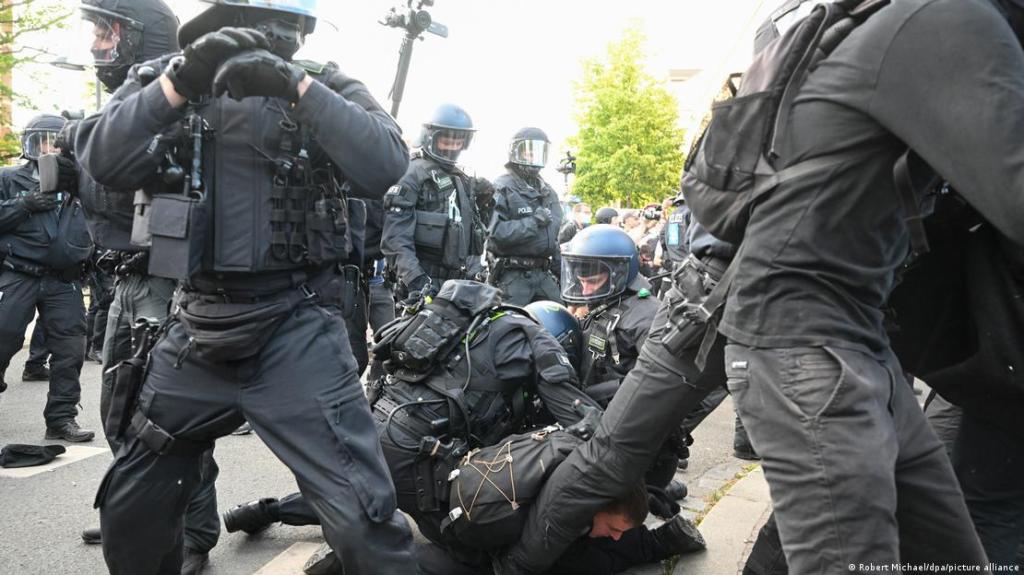
Confrontations which German police are organized to handle so that protesters, irrespective of political persuasion, are treated firmly. And treated by the Courts in a manner which respects their rights. While meting out to the accused firmly and, for the post part, fair sentences to the Guilty.
In America law enforcement more often comes down hard on progressive protestors. And, too often treats right wingers with the proverbial kid gloves.
Vigorous street protest is rarely seen in America where, for the most part, aggrieved Progressives satisfy themselves with generally peaceful marches and overheated rhetoric.
The same protest tactics can’t be said for the far right in America. Proud Boys, Q’Anon etc. The neo-fascist extremists whose attempted coup d’etat on January 6, 2021 laid bare the incendiary intentions of these political thugs.
The Courts in America seem unable to differentiate between neo-nazi extremists and legitimate political protest. In America the Courts often hand out unduly long prison sentences.
Particularly for political offenses; i.e. whistleblowing and making public government documents. Charged as serious crimes which do not deserve lengthy, if any, incarceration.
If nothing else, in Germany the Courts are more adept at making the punishment fit the crime.
Excerpted from Deutsche Welle 6.3.2023

Several police officers were injured in the eastern German city of Leipzig on Saturday in clashes with left-wing protesters.
Leipzig police spokesman Olaf Hoppe described the situation as “very dynamic,” with “sometimes massive clashes here in the south of Leipzig.”
He said that “roughly 1,500 people” turned up to the demonstration, even though several courts had refused to authorize it.
“According to our estimates, one-third of them were either inclined towards violence, or were actively seeking violence,” Hoppe said. “We observed numerous cases of people intentionally obscuring their faces, which is an offense in and of itself.”
Major protests in Germany require authorization from authorities. Local governments and courts can restrict them if they deem that the event could pose a risk to public safety, among other reasons.

The activists are demonstrating in the aftermath of a young woman from Leipzig, identified as Lina E., receiving a 5-year jail term earlier in the week for her part in organized attacks on neo-Nazis in Germany. She also received a last-minute reprieve of sorts, when the judge said she would only have to serve the remainder of her jail sentence should she also lose at appeal.
The scheduled date for the verdict had been known for months, and Lina’s supporters evidently were not optimistic about her chances of acquittal, as they had been drumming up support for protests on the following weekend since last year.

They referred to it as “day X” (Tag X), a term often used in German to describe a moment in the future that you believe will be somehow decisive or crucial.
They wanted to stage the march under a motto that roughly translates as “United we stand — defend autonomous antifascists, in spite of all this.”
Leipzig city authorities and two courts in the city ruled that Saturday’s demonstration should not go ahead, saying that advanced online appeals calling on people to protest either showed a tendency towards violent acts or sometimes even included explicit calls for violence.

“Leipzig’s Higher Administrative Court is also of the conviction, that the city of Leipzig plausibly predicted that the protests could turn violent and therefore pose a threat to the broader public,” Leipzig’s Higher Administrative court said late on Friday when upholding the first court decision finding that the march should not be allowed.
The German Constitutional Court, meanwhile, said on Saturday that it would not hear a last-gasp emergency injunction on the issue, meaning the protesters had exhausted their legal avenues.
https://www.dw.com/en/germany-police-break-up-banned-far-left-protest-in-leipzig/a-65816770
Top photo – Police in Leipzig, Germany push away a protester
 Lee's Perspective