


SAN FRANCISCO
Lee Heidhues 9.10.2026
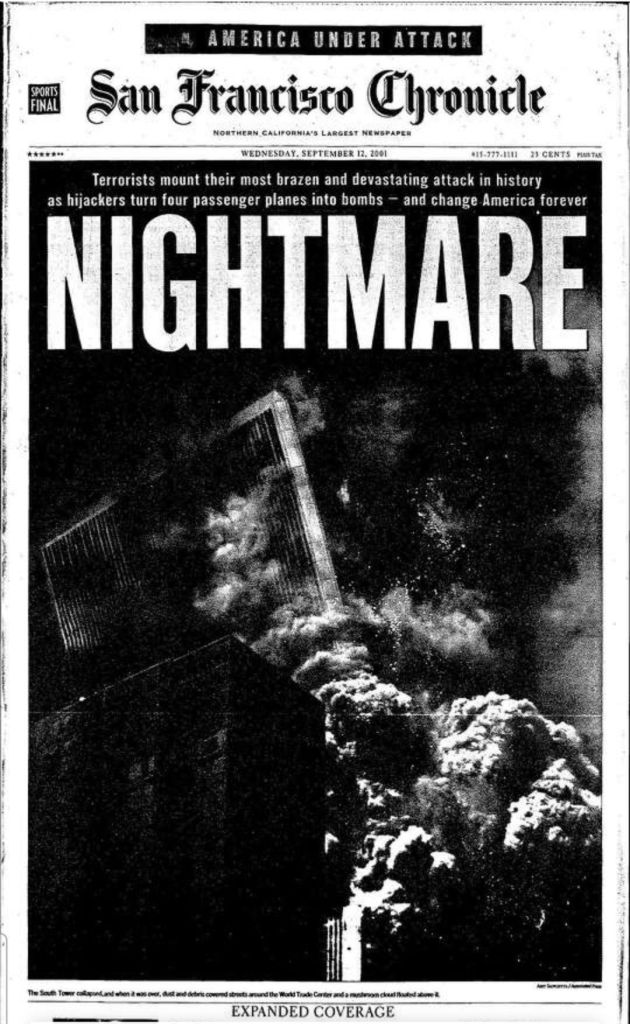
On September 11th 2001 the blogger heard the news on NPR Morning Edition. Not realizing the severity and impact he set off for work downtown. Midway there he received a call from Liz telling him the office had called and told him not to come to work that day. And as it turned out for several days thereafter.
25 years later the media is busy commemorating the 25th anniversary of the 9/11 terrorist attacks.
Deutsche Welle is reporting the now well known fact that several of the 9/11 hijackers lived in Hamburg prior to the assault on America.
Predictably this historic event has been compared to the Japanese attack on Pearl Harbor December 7th 1941.
Predictably, it was also inevitable that the film industry would offer its interpretation of 9/11. Two films illustrated the cinematic effort. “Zero Dark Thirty” recounted the years long effort to locate and kill Osama Bin Laden. “A Most Wanted Man”, a John Le Carre novel put to film, is the story of post 9/11 Germany’s anti-terrorist campaign. Scenes from these films are posted below.

Excerpted from Deutsche Welle 9.9.2026
The 9/11 plot, including the twin tower attacks, was partly planned by the so-called Hamburg cell. A look at how Germany’s national security was reshaped.
German Chancellor Gerhard Schröder addressed parliament the following day.
“Yesterday, September 11, 2001, will go down in history as a dark day for all of us,” the Social Democrat said.
He said he had expressed to the American president the deeply felt condolences of the entire German people.
“I also assured him of Germany’s unconditional — I emphasize: unconditional — solidarity,” Schröder said.

“This day has changed the world,” German President Johannes Rau said. He had watched in shock as the burning twin towers of the World Trade Center collapsed in New York.
Germany’s head of state struggled to find the right words: “We do not know what political or social consequences what happened today will have — what we have watched unfold on our television screens in shock, barely able to comprehend or even reflect on it.”
Germany, he added, would offer the US any assistance they requested, “of course, also by identifying and pursuing those responsible for and behind these despicable attacks.”
It soon emerged that the victims include people from 92 countries, among them 11 Germans.
Mohammed Atta and the Hamburg cell
The following day, a rapidly spreading rumor was confirmed: Three of the four suspected hijackers had recently lived in Hamburg. The Islamist terrorists were thought to have been led by Egyptian-born Mohammed Atta, who had come to the northern German city in the early 1990s to study.

Image: dpa/picture alliance
At some point, the young man became radicalized, particularly at Hamburg’s Al-Quds Mosque, which was later closed by German security authorities. He spent the final three years of his life in an apartment shared with two other suspected attackers in the Harburg district.
Schröder’s remarks set the tone and opened the door for a series of tougher laws. Just weeks after the attacks, the governing coalition of Social Democrats and Greens unveiled its first so-called security package, involving more funding, more personnel as well as greater powers for police and intelligence agencies.
Religious organizations that had previously been granted special protection could now be banned like other associations if their activities were directed against the Basic Law, Germany’s constitutional order based on freedom and democracy, or if they pursued other criminal aims. Less than four months after the terrorist attacks in the US, Germany’s Anti-Terrorism Act took effect.

Intelligence agencies were given access to personal data held by banks, airlines and telecommunications companies. Immigration laws were tightened.
Through data-mining searches, in which large amounts of data were cross-checked without any specific suspicion, authorities sought to identify so-called sleeper agents — people like Mohammed Atta from the Hamburg terrorist cell, who had not been identified by security agencies in time.
The Federal Constitutional Court brought an end to the legally questionable practice. Such searches were permissible only when there was a specific threat, the court said in a 2006 ruling. Seven years later, Germany’s highest court also ruled that parts of the country’s anti-terrorism database were unconstitutional.
Nearly 3,000 people were killed on September 11, 2001, when Islamist terrorists hijacked four passenger planes and turned them into deadly weapons.
Top photo: First responders at Ground Zero


