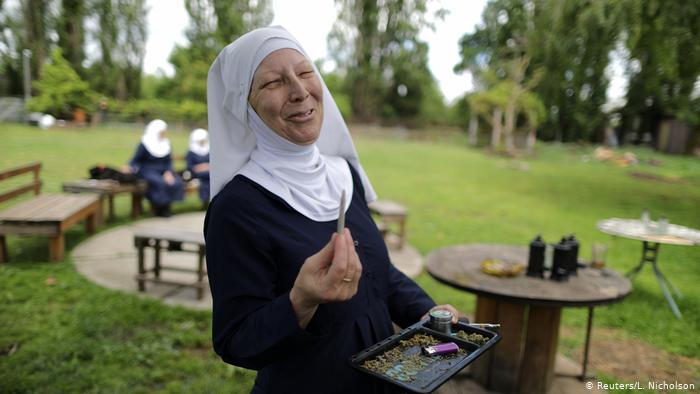

Sex in times of the coronavirus. The bedroom view from Germany.

The Germans are practical.

Deutsche Welle 3.23.2020

Social distancing is the order of the day, so it’s not a good time for sexual contact. It’ll be toughest for single people. But for couples, isolation could prove to be a second honeymoon … or hell on Earth.

The coronavirus is changing everything, including our sexual relationships. The most obvious sign of that in Berlin was evident one Friday evening in mid-March: The doormen had disappeared from Insomnia, the German capital’s famed club for swingers, fetishists and hedonists, along with the otherwise usual line of sexual libertines along the sidewalk.

Instead, there was only a note on the door announcing that the Berlin state government had ordered all clubs to be shut down. On the club homepage, Insomnia manager Dominique and the team posted an optimistic message: “Stay healthy, protect yourselves, and hopefully we’ll be able to party together in five weeks’ time.”

Bad time to be single

Sex Covid 19 III 3.23.2020.jpg

Though Berlin’s clubs were already closed, restaurants and cafés were still open in mid-March. As one young woman sitting with her friends outside a bar in the spring sunshine told DW with a laugh: “The coronavirus had to come in spring, of all times. Doesn’t look good for us singles.”

Soon afterwards, all the dance schools, restaurants and bars in Berlin also shut down: all the places where singles usually get to know each other, either to fall in love or for a sexual adventure.

Author and couples therapist Wolfgang Krüger offers a curt response: “Single people are generally left high and dry, coronavirus or no coronavirus. A married 60-year-old woman gets significantly more sex than a single 30-year-old. The quality of sex for single people is generally worse, too.”


Sex Covid 19 II 3.23.2020


To improve their chances, millions of men and women look for the right partner on dating sites. So has virus anxiety set in among them? One such German dating agency, Parship, claims in its advertising that one person falls in love every 11 minutes thanks to its services.

Parship spokeswoman Jana Bogatz says she has not yet noticed a fall in membership rates and even claims to see a benefit for the business in the current situation: “Everyone is being called on to reduce social interaction to a minimum, which, of course, limits dating possibilities,” Bogatz says. But, she says, people can stay in contact online and even make new contacts, since “meeting people offline is only partly possible at the moment.”

However, the question is whether people will be satisfied with what could be months of writing messages, or whether they might not risk infection for a brief tryst after all.

Read moreWhat are Germany’s new coronavirus social distancing rules?

As ever, though, one person’s poison is another’s tonic. As single people are now forced to provide for themselves, the demand for pornography and sex toys is booming. Sex shops have switched to online trading, with the more entrepreneurial ones even offering a taxi delivery service, which offers at least a little income for taxi drivers who have seen their own businesses crash.

Couples have home advantage

Not having to find a sexual partner makes things easier for couples. For some, pausing normal life and staying at home might be a source of sexual reinvigoration, seeing as there isn’t much else to do — gyms, cinemas, theaters are all shut down. Football, too, is something that belongs to a past world.

Though the pendulum might also swing the other way, as was the case for Rolf. For many years, work has meant that Rolf has had to live apart from his wife during the week. So, initially, he welcomed the chance to work from home: a good opportunity to finally live together properly, not just at the weekend.

A week later, and nerves were fraying for both of them. Joint tasks, such as cleaning the windows, occasionally ended in a full-on marital row. Rolf decided to move his self-isolation back to Berlin: “Forced cohabiting is like a forced marriage. And sex isn’t fun then, either,” he said.

Couples therapist Krüger isn’t surprised. “Their distance rules have been scrambled,” he said — the partner is always there and alway available. “Erotic desire arises from an alternation of proximity and distance,” he says.

But couples who have mastered the game of proximity and distance could well be in for a good time. “In times of panic and fear, sexual desire can also rise,” Krüger said. “Sexuality is the best way to drive away angst.”

A coronavirus baby boom?

And if people do find new inspiration for their sex lives, it might have fruitful consequences. Krüger, looking nine months into the future, is certain, anyway: “More children will be born.”

But — what a pity! — there is no scientific statistical evidence for this, though the question is raised whenever there are blackouts or longer periods of bad weather.

https://www.dw.com/en/sex-in-times-of-the-coronavirus/a-52889374


California renters push law for right to organize, go on strike against landlords

The Coronavirus crisis has brought the debate over housing rights to an entirely new level. 

California renters, who far outnumber landlords, are pushing the State legislature to ensure the rights of renters to go on strike and organize against corporate landlords.

It will be a brutal battle as corporate landlords are well entrenched with lobbyists and deep pockets.

San Francisco Examiner 3.22.2020

Coronavirus lockdown adds urgency to fight for protection from retaliation

Among the legislation to be delayed by coronavirus this month is a potential state law that would allow tenants to go on strike and enforces their right to organize amid tension with corporate landlords.

“People being forced out right now in order for a corporate landlord to meet their bottom line, it’s not just morally wrong” Tenants Together Lupe Arreola said, “but it’s actually going to exacerbate our current public health crisis. It’s important tenants have the tools to help defend their rights to be in their homes without the risk of being pushed out.”

Tenant organizers are looking to Senate Bill 1404, to be introduced by Sen. Maria Elena Durazo and sponsored by Tenants Together, to codify rights around tenant associations and organizing. This includes penalties for retaliation and the right to withold rent, which would be put in escrow after landlords and tenants fail to come to an agreement on an issue like habitability and rent increases.

“Right now with this humanitarian crisis, we want to strengthen the protections,” Durazo said. “If you have the right to organize but you don’t have anything that protects you against retaliation, there’s still that imbalance of power.”

Tensions around tenants’ right to organize have increased in San Francisco since Veritas, known as the city’s largest landlord, put 76 buildings up for sale in December. Tenant organizers have reported more confrontations with building managers, who argue that California Civil Code 1942.6 doesn’t allow them to knock on the doors of all other residents after being let inside by one to discuss tenant issues.

Berlin Property nationalization 4.7.2019

Tenants Together, sponsor of SB 1404 and SB 529, feels there’s a strong need to prevent retaliation against tenants utilizing organizing rights. Assemblymember David Chiu, who represents San Francisco, championed Assembly Bill 1482 to institute just-cause evictions and instill rent caps, but executive director Lupe Arreola said enforcement was needed.

“There isn’t any clear enforcement mechanism at the state or local level that will help tenants enforce these rights,” Arreola said. SB 1404 “basically forces the owner to continue to engage with the tenants to help resolve the issues, otherwise tenants can withhold rent for 30 days.”

SB 1404 would expand enforcement of AB 1482 to local jurisdictions, which would involve the city attorney, district attorney or county counsel. But Durazo’s intention with the right to a rent strike would bring landlords to the negotiating table so it may be worked out before falling to the government.

At the moment, door-knocking has been put on hold while The City hunkers down to prevent coronavirus from spreading. But organizers have had plenty to keep them busy and are working to prevent others from losing their homes during or immediately after the shelter in place order ends April 7, when many people will likely struggle to make rent.

Tenant advocates have called for a blanket moratorium on rent and mortgage payments, and for Veritas to stop collecting rent during the pandemic. Last week, Veritas said it would voluntarily suspend evictions for residents financially impacted by the health crisis.

The California Legislature’s recess through April 13 during the COVID-19 crisis has caused delays with the legislative counsel, which is needed to draft language before it can be introduced. Durazo introduced a similar bill in 2019, Senate Bill 529, but it failed by one vote.

https://www.sfexaminer.com/news/tenants-look-to-state-bill-to-boost-right-to-organize-strike/


Babylon Berlin Is the Best Show You’re Not Watching

In the time of the Coronavirus with plenty of time at home Babylon Berlin is the television series not to be missed.
Now in its third season this German production is riveting, intriguing, artful and dystopian.
The portrayalof Germany during the Weimar Republic which ended with the ascension of Adolf Hitler to power in 1933 is a mind bending history lesson.
3.3.2020

Two years ago, I became completely obsessed with a TV show called Babylon Berlin. This is not uncommon for me. Falling for a show and evangelizing for it with a fervor bordering on obnoxious is one of my very favorite things in life. Objects of my “Why aren’t you watching?” jeremiads have ranged from Fleabag to Halt and Catch Fire to Dickinson to the recent CBS procedural Evil. But my love for Babylon Berlin had a different tenor.

The series, whose third season just hit Netflix, is so byzantine, so chockablock with plot, so twisty and propulsive — it’s the kind of show you get to the end of, and then desperately need to talk about with every single person you see for the next week. It is the most expensive non-English-language TV production ever, it’s been sold to 100 countries, and it’s epically, outstandingly gripping. But because it’s a German show, and because it’s a hard-to-categorize mix of many genres, and because it’s gone almost entirely unpublicized in the U.S., Babylon Berlin is so unknown here that I feel like I’ve been yelling about a TV show from a different planet.

When the show landed on Netflix for the first time two years ago, I was unprepared. I had no idea what it was, and no idea how much I’d love it. Now that the third season is available to audiences outside of Germany, I will not be caught unprepared again: It is time to talk about the greatness of Babylon Berlin.

Babylon berlin 3 I 2.1.2020

The series is a historical drama about the Weimar period of Berlin — think Cabaret, opulence, extreme poverty, avant-garde innovation, genderqueer performance, Surrealism, and the imminent pendulum swing of reactionary cultural conservatism (nationalism and Nazis). It’s a historical moment where many different kinds of thinking exist all at once, all crammed into the same growing, vibrant, unstable urban space. Babylon Berlin, which is based on a series of mystery books by Volker Kutscher, is all of those things, too. It’s first and foremost a noir, and the story begins with a detective named Gereon Rath who comes to Berlin from a more provincial part of the country so he can track down an extortion ring. He is the consummate noir detective: both an outsider and a knowing investigator, talented and haunted, capable and a touch naïve.

But rather than the specifics of Gereon’s investigation, Babylon Berlin’s world is what hooked me first. It’s beautiful and stylish and grim and dynamic. There’s an early sequence in the first episode where the show’s other main protagonist, a young woman named Lotte, gets ready for a day of work. She lives in a filthy, crowded, much-too-small apartment with her extended family. Everything is gray and brown, no one has enough food, and the clothes she puts on are just as grimy as everything else. As she walks out of her building, she pulls a grass-green cloche hat onto her head, by far the most colorful object in the whole scene. She ties a pair of hose around her neck like a scarf. Lotte is transformed, suddenly visible in the world. When she walks across a public plaza and rides a street car, her bright-green hat is a confident beacon, letting her pass in any context: a club, a police station, a professional office, a fancy shop, a pub.

Gereon arrives in Babylon Berlin like a ticking clock of plot mechanism, but he moves through the city like a blindfolded person, bumping into everything and finding his way mostly by luck. Lotte is the character with her eyes open, the one who can slip seamlessly into any new space, who understands all the unspoken stuff Gereon can only pluck at helplessly. It’s a classic storytelling pair: Gereon is the audience stand-in, the one who has no idea what’s going on and needs someone to explain everything, and Lotte is the wise and obliging guide to this new, unusual world.

But the world of the show is so complex and detailed and occasionally surreal that sometimes there’s just no easy explanation. There’s no simple way for Gereon to say, “Hey, what’s the deal with this absolutely bonkers cabaret that’s run by the mob, frequented by German nationalists, and featuring drag-king performers who bring the house down with a song about love and death?”

So the show just sweeps you along anyhow, and expects that you’ll keep up with the half-dozen or so interlocking and ever-changing threads. There are stories about secret military bases and a nationalist plot to bring down a powerful democrat; there are plots about hidden histories and the buried trauma of the first World War; there are revelations about secret identities and murderous plots and several twists so dramatic and effective that they gave me the kind of vicarious adrenaline rush I usually associate with unexpected good news or just barely catching a flight.

https://www.vulture.com/2020/03/babylon-berlin-season-3-review-please-watch.html

Link to Season 3 Trailer

https://www.youtube.com/watch?v=iCbs4634t4E


Strangely competent VP Mike Pence finds his 9/11 moment in coronavirus crisis

Who would have thought????

Compared to his boss, Mike Pence assumes genius like qualities and becomes a Mainstream Media favorite as a figure of recitude and calmness.

The Guardian 3.21.2020

Critics flagged up his anti-science background and questionable record as governor but the vice-president has won praise as the Covid-19 taskforce head

His past record made him seem an odd choice. He remains as servile to Donald Trump as ever. But Mike Pence, the US vice-president, is said to be having “a good war” against the coronavirus outbreak.

When Trump named him chair of the White House coronavirus taskforce, it led some to wonder whether the president, facing a tough election in November, was looking for an easy scapegoat if everything went wrong.

However, Pence, 60, earned early plaudits for his cool head and assured performances in the cacophony of the White House briefing room – probably benefiting from comparison with his volatile boss and two divisive press secretaries. Indeed, this week Trump has reasserted himself as the face of the administration as if to ensure Pence does not claim too much of the limelight.

Pence II 3.21.2020

Trump’s decision to put Pence in charge of the coronavirus effort triggered an outcry. Critics noted that Pence once wrote an article that claimed “despite the hysteria from the political class and the media, smoking doesn’t kill”. More recently, as governor of Indiana, he failed to act swiftly as HIV spread among drug users, and he has been reluctant to accept the evidence for the climate crisis.

But D’Antonio, who wrote a column headlined “Mike Pence is exactly the wrong guy for this job”, has been pleasantly surprised. “I thought maybe Trump was using him as the fall guy, but it could be that Mike learned something from those previous experiences in Indiana. They were formative, especially the issue around the HIV outbreak.

“He’s not so cold and detached that he can’t imagine people contracted HIV in the time he dithered. This may be a way for him to redeem himself. I think he has the capacity for redemption; I’m not sure the president does.”

More than a year since the last formal press briefing, Pence, a former talk radio host, has been welcomed as a steady presence at the lectern along with scientists and experts.

Jack Shafer, a media columnist at the Politico website, wrote that he “acted less like the ‘coronavirus czar’ and more like a good old-fashioned White House press secretary. He was calm. He was direct. He was polite in face of shouted, competing questions.”

David Axelrod, former chief strategist for Barack Obama, tweeted this week: “Other than the incessant fawning, the @VP is a far better briefer than his boss. Tries to stick to facts.”

This week, for example, as Trump continued to offer upbeat assessments, Pence delivered a dose of realism: “There will be many thousands of Americans that contract the coronavirus,” he told National Public Radio. “We fully expect that we will be dealing with the coronavirus in the United States for months.”

Pence’s past experience as a former governor reassured some state governors currently at the frontline of the crisis. He was able to build bridges with Jay Inslee, the governor of Washington state, even as Trump dismissed Inslee as a “snake”.

D’Antonio added: “He’s done very well. He’s felt very confident in the president’s support because he laid so much of the foundation of praise for Trump in the past. He’s established he’s always going to give the spotlight to Trump and he’s always willing to accept the blame if necessary.

“He’s had his chin out and he’s willing to take a knock if one is coming. He’s hung in there and let himself be used, and now he’s of use. You still cringe as you hear him be so unctuous but you’ll notice others are doing it too.”

Whatever happens in November, Pence is seen as a likely contender for the Republican nomination in 2024. D’Antonio believes he has boosted his chances. “If things go poorly for Trump, Pence stands as the more serious and inspirational leader right now. If people had a problem with Pence, it’s often over the idea that he’s anti-science. This is doing a lot to counter that.

The vice-president’s constant praise for Trump, however, incessantly peppering his remarks with the phrase “the president”, is likely to win him few friends among Democrats and independents, however.

Jeff Greenfield, a political analyst and author, tweeted on Wednesday: “Have some sympathy for Mike Pence. I’ve learned that there is an electrified belt around his waist and if he speaks for more than 7 seconds without praising the President, a White House aide presses a button and Pence suffers a painful shock.”

Is Russia running a coronavirus disinformation campaign?

A Russian campaign to spread disinformation about the Coronavirus has been gaining traction in Europe and the United States.

With so much information being circulated almost minute by minute on every media outlet, it’s hard to separate fact from fiction.

Deutsche Welle 3.20.2020

Is Russia using the coronavirus pandemic as a chance to incite unrest in the West by spreading fake news and misinformation? EU observers of Russian media say that’s what it looks like.

The Russian news outfit Sputnik claims “very smart biologists and pharmacists” in Latvia invented the new COVID-19 coronavirus. Other sources close to the Kremlin say it was made in the British military’s Porton Down facilities.

Russia observers from the European Commission have so far analyzed 80 different reports containing false or misleading information about coronavirus published by official Russian state media sites as well as platforms and authors with close ties to the Kremlin. But does that activity constitute a deliberate campaign, or is it just part of the ongoing propaganda war between Russia and the West?


Read moreHow not to protect yourself from the coronavirus

‘Confusion’ is the message

Excerpts of those reports, which can be seen on the website EU vs. Disinfo under the title, “The Kremlin and Disinformation About Coronavirus,” are at times astonishing. The authors note that it is easy to get the impression that the reports are entirely contradictory. For instance, the Oriental Review, an e-journal with ties to the Kremlin, wrote: “When the panic is over, COVID-19 will have killed less people than a normal flu.” The article argues that current fears about the new coronavirus are racially-fueled.

Alexander Dugin, a Russian nationalist and a very public supporter of the Orthodox Church, claimed exactly the opposite at Geopolitica, another Russian e-journal. Dugin said when the virus finishes its “victory march across the planet” it will have destroyed the existing world order. In his moral and religious castigation of Western lifestyles he often draws on symbols such as vengeful ancient gods or biblical plagues.

But is there some sort of plan behind all these contradictory claims? EU observers suspect the aim of the campaign is to confuse European citizens by, “sowing disunity and mistrust.” Peter Stano, lead spokesman for Foreign Affairs and Security Policy for the EU, explains: “We have seen an increase in the amount of misinformation originating outside the EU. Some has been Russian, spread by Russian providers and pro-Kremlin sources.” Stano says Russia isn’t the only source of foreign misinformation, before adding that wherever such misinformation is coming from, “it threatens people’s lives.”

liz-coronavirus-art-3.18.2020.jpg

Denials and interpretations

On Wednesday, Kremlin spokesperson Dmitry Peskov strongly denied reports of a Russian coronavirus disinformation campaign that had been printed in the Financial Times newspaper“We are talking about unsubstantiated claims that are, considering the situation, likely the result of an anti-Russian obsession.” Peskov called the claims absurd, adding that no concrete evidence had been offered to substantiate them.

Peskov’s denial won immediate support from Russia’s foreign broadcaster Russia Today (RT). The RT website quickly published an article by Nebojsa Malic, whom RT says is a Serbian-American journalist, which read: “When all else fails, blame Russia. That seems to be the EU approach to deflecting blame from its response to the coronavirus pandemic.”

Nimmo says the case was different after the downing of Malaysian Airlines Flight MH17 or the annexation of Crimea. In both of those situations media outlets all used the same script, a clear indication of Kremlin orchestration. With the coronavirus, says Nimmo, things are different. Media outlets like Sputnik and RT knew they wanted to paint the West in a poor light no matter what.

When Russia expert and Green Party EU Parliamentarian Sergey Lagodinsky looks at Russian media coverage of COVID-19, he says, “It reflects the nature of our relationship.” He says the current attitude is that Russia has had few cases of COVID-19 so far and the EU is being overrun with them, so Russian media groups are using the situation to keep stoking panic.

https://www.dw.com/en/is-russia-running-a-coronavirus-disinformation-campaign/a-52864106

To Track Virus, Governments Weigh Surveillance that pushes Privacy Limits

Government agencies are pushing hard to track the Coronavirus as it continues its worldwide march.

The use of surveillance technology is one of the tools being utilized by government agencies. There is a growing concern that such tools will become yet another intrusion into the privacy of citizens.

At what point is the need to eradicate the Coronavirus come into conflict with personal privacy?

Wall Street Journal 3.17.2020

Geolocation and facial-recognition systems can locate vectors of infections, but they also gather highly personal data

As the country scrambles to control the rapidly spreading coronavirus, government agencies are putting in place or considering a range of tracking and surveillance technologies that test the limits of personal privacy.

The technologies include everything from geolocation tracking that can monitor the locations of people through their phones to facial-recognition systems that can analyze photos to determine who might have come into contact with individuals who later tested positive for the virus, according to people familiar with the matter.

coronavirus surveillance II 3.19.2020.jpg

Data-mining firm Palantir Inc., which was credited with helping to find Osama bin Laden, is working with the Centers for Disease Control and Prevention to model the virus outbreak. Other companies that scrape public social-media data have contracts in place with the agency and the National Institutes of Health, documents show.

The push is in part being coordinated by a task force working in conjunction with the White House, and includes startups as well as tech giants such as Alphabet Inc.’s Google unit, Facebook Inc. and Amazon.com Inc. The task-force discussions involving the White House and tech companies were reported by The Wall Street Journal on Sunday.

Other efforts are more grass-roots, with tech companies pitching state agencies and governments.

Tech and government officials are struggling to find a balance between deploying technology and keeping patients’ data—particularly medical information—safe. Some privacy advocates worry that little has been disclosed about what is being planned or implemented.

A man standing earlier this month at a building entrance in Shenzhen, China, fitted with an AI computer, made by the company SenseTime, that identifies even masked individuals and detects whether they have a fever.

PHOTO: ALEX PLAVEVSKI/EPA/SHUTTERSTOCK

Technology executives spent much of an hour-long call Sunday discussing ways to track hospital-bed availability across the country using geolocation data, but also how the data could be aggregated so that personal information of cellphone users wouldn’t be shared, according to people familiar with the call. It isn’t clear which companies would handle that kind of tracking.

Other countries have already deployed location-tracking systems and other tech solutions to fighting the pandemic, but many such efforts could run afoul of U.S. privacy laws.
In China, telecommunications companies helped the government track and contact people who had traveled through Hubei province during the early days of the virus. Location data was funneled to China’s National Health Commission and other agencies, allowing them to re-create the steps of virus carriers and people that they may have encountered and issue warnings via social media.

As part of the task-force discussions, Facebook and Google are exploring ways to use data to help the U.S. government track outbreaks of the disease, according to a person familiar with those discussions.

Facebook is already sharing disease-migration maps to help combat the spread of coronavirus, a company spokesman said.

In the U.S., the government could legally request location data from telecom carriers or from Google, which has access to more-precise data belonging to its Android and Google Maps users, said Al Gidari, director of privacy at Stanford Law School. This information can’t typically be released without user consent or a court order, but the government has broader authority to request such data in the event of an emergency, he said. “I don’t think anybody would dispute that this is an emergency,” he said.

White House and CDC representatives didn’t respond to requests seeking comment.

Camber Systems, a Washington, D.C., location-tracking startup founded by former government officials, says on its website that it leverages “data, machine learning and artificial intelligence” to help cities manage transportation and infrastructure. The company is among the firms in talks with the White House, according to people familiar with the matter. The company hopes to work with state and local agencies to use its data.

“If we’re to leverage commercial technology to save lives, how do we put in the policy framework so we’re not South Korea or China or Israel?” said Ian Allen, Camber’s chief executive, in an interview.

Sen. Ron Wyden, a Democrat from Oregon, is among the lawmakers who is investigating this activity. In a statement, Sen. Wyden said the efforts are sensible as long as the appropriate conditions are in place. “There must be procedures to keep this information safe, to delete information once it’s no longer in use, and to ensure it isn’t used against Americans by law enforcement,” he said

.“We understand that given we are in this crisis, that some temporary adjustment of our digital liberties may be necessary, however it’s really important that those adjustments be temporary,” said Adam Schwartz, a senior lawyer at the Electronic Frontier Foundation, an advocacy organization for civil liberties and technology. It is crucial, he added, for governments to be transparent about the technology they are using and to put safeguards for consumers in place.

Clearview A.I. Inc., a facial-recognition startup that has sparked controversy among privacy advocates over its use by police departments, is in discussions with state agencies about using its technology to track patients infected by the coronavirus, according to people familiar with the matter.

The technology has yet to be adopted by any agency, but the New York-based company hopes it will be helpful in what’s known as “contact tracing”—figuring out who else might have been with a person known to have the virus.

Palantir is working with the CDC on data collection and data integration related to disease tracking, according to a person familiar with the company,

During the cholera outbreak in Haiti in 2010, the CDC used Palantir to “monitor the situation and inform their response efforts,” according to a white paper later published by Palantir. The company’s technology allowed government analysts to “explore text messages” between Haitians and a text platform built by an outside technology company.

The company said it is making privacy a priority.

“Data-driven responses to the Covid-19 pandemic must treat good data governance, including privacy and civil-liberties protections, as guiding concentrations along with the mission objectives, not as afterthoughts,” says Courtney Bowman, head of Palantir’s Global Privacy and Civil Liberties Engineering team, in a statement.

Crimson Hexagon, now part of Brandwatch, has a $30,000 contract with the CDC that was initiated last fall, according to government records. Crimson provides companies and governments with “social listening” tools, meaning it scrapes public Facebook, Instagram and Twitter posts in part to gauge sentiment.

Before its merger with Brandwatch in 2018, the company ran afoul of Facebook’s privacy policies, and former employees told the Journal at the time they were concerned government agencies used the service for surveillance.

A Brandwatch spokeswoman said the CDC contract encompasses the National Center for Injury Prevention and Control, which uses the company’s technology to “gain an understanding of historical and recent trends in injury prevention topics.”

San Francisco tenant attorneys fight to stop evictions during Coronavirus

Led by Supervisor Dean Preston, a tenants rights attorney, local tenant attorneys are petitioning and imploring San Francisco Superior Court to halt all eviction proceedings during the Coronavirus crisis.

48 Hills – Tim Redmond 3.18.2020

Landlord lawyers are still demanding that courts rule against tenants and hold trials — right now, despite shelter-at-home rules.

The mayor has declared a moratorium on evictions for nonpayment of rent. The sheriff has announced that they will “postpone all evictions until further notice.” The local Superior Court is continuing all non-essential civil cases for as much as 90 days.

But the landlord lawyers don’t care.

Supervisor Dean Preston wants a moratorium on all no-fault eviction cases.

As of Tuesday tenant lawyers tell me, Ellis Act evictions continue to arrive – and landlord lawyers are in some cases refusing any continuance.

Sup. Dean Preston put out a tweet yesterday:

Just learned of a landlord refusing to delay an Ellis Act eviction of a disabled tenant during this COVID-19 crisis. Here’s what the attorney wrote

“It is not my clients’ duty to build in protections for a pandemic or emergency. They are unwilling to extend the time, or amend the agreement to have stays of execution or extensions of time”

The landlord’s attorney also writes that “all trial court appearances are to be in person, and “preference” cases are not being continued.” In other words, the landlord is pressing forward and the court’s delay of other cases doesn’t apply to eviction cases.

Preston isn’t the only one hearing about this. Tom Drohan, director of litigation at Legal Assistance for the Elderly, told me that the courts are still planning to hear eviction cases.

“Although the San Francisco Superior Court has continued all jury trials for 90 days in the interest of public health,” Drohan said, “certain cases called preference cases are exempt from this ruling. Eviction cases are considered preference cases and therefore will be going forward as scheduled.”

Ken Garcia, a spokesperson for the Superior Court, confirmed that “Under the law (and until the legislature amends it), unless one of the parties waive their rights, the [eviction] cases must be heard.”

That would mean that, during a shelter-in-place order, tenants, many of them elderly or otherwise vulnerable, will have to appear in court for an eviction trial. Lawyers will have to show up. A jury will have to be empaneled. All of these people will be in close contact.

And even if the sheriff doesn’t carry out the evictions immediately, the legal judgment will still be on the record, and the tenants may be forced out as soon at the Sheriff’s Office decides to resume.

This is insane.

Drohan said that a group of tenant lawyers, working together, appeared Wednesday in Courtrom 501 to file motions for continuance in each of their eviction trials. Word is that some landlord lawyers may actually object.

Preston, at Tuesday’s board meeting, said that the evictions have to stop.

“I am calling on the Governor, the Courts, and the Mayor to immediately suspend all eviction activity, except for evictions that are necessary to protect from threats to safety,” Preston said. “Right now, eviction notices are being served in San Francisco and eviction cases are moving forward.  This is the last thing we need.”

Preston introduced an emergency resolution calling on the governor to expand his executive order to impose a moratorium on all evictions, and specifically to waive and suspend the provisions of the Ellis Act, asking the courts to stay all eviction lawsuits, with limited exception for tenants posing a serious danger to the safety of others; and asking the mayor to expand her emergency directive limiting certain nonpayment evictions to cover all no-fault evictions during the state of emergency

“I have seen a lot of good from people in the last week, with an outpouring of neighbors reaching out, asking how they can help. Some of those include landlords in my district,” Preston said. “But unfortunately, there are those who seem to lack compassion at this time, and it is to deal with them that we must take the actions at all levels of government to stop evictions in this time.”

San Francisco pot dispensaries win reprieve. Still ok to purchase Weed

The stay in place Order is tough to handle.  But forcing pot dispensaries from selling their product was one toke over the line too many.

San Francisco City Hall decided to keep the dispensaries open for the locals who need a little help in weathering the trauma of Covid-19.

It keeps a segment of the population working and brings in lots of tax revenue. San Francisco needs it.

San Francisco Chronicle 3.18.2020

Long lines were reported at cannabis stores in San Francisco and the East Bay because of the shelter-in-place orders.

San Francisco officials are allowing cannabis businesses to remain open while many other stores are shut down over the next three weeks as the city goes to extreme lengths to fight the coronavirus pandemic.

City officials originally told cannabis stores they had to close on Tuesday because of the city’s order one day earlier to close nonessential businesses and have residents stay at home as much as possible. But then the San Francisco Department of Health sent a tweet calling cannabis “an essential medicine for many San Francisco residents.”

“Dispensaries can continue to operate as essential businesses during this time, while practicing social distancing and other public health recommendations,” the department said in its tweet.

The initial directive had frustrated businesses and advocates who want cannabis to remain available, especially for medical patients, while residents in San Francisco and other Bay Area counties shelter in place until April 7.

SF Cannabis II 3.18.20.jpg

Restaurants were allowed to offer delivery and takeout, but the same was not true for San Francisco’s cannabis businesses at first. An email sent Tuesday afternoon by the city cannabis office and public health department said businesses should be closed Tuesday but signaled that changes could come soon.

In the meantime, some of the city’s most visible cannabis operations were temporarily shuttered.

“For now we are completely closed,” said Eliot Dobris, a spokesman for the Apothecarium dispensary, which has three locations in San Francisco. “We have raised the issue of access for medical patients and are in ongoing discussions with the city. Many of our guests with true medical needs have not bothered to get medical cards over the last couple of years, since recreational use became legal.”

Others that stayed open in San Francisco and other parts of the region forced customers to separate themselves as mandated by the health orders. Harborside’s Oakland dispensary said Tuesday on Twitter that it had “limited in-store capacity for social distancing.”

SF Cannabis I 3.18.20.jpg

Eaze spokeswoman Elizabeth Ashford said the company was hoping the city order would change to allow for cannabis deliveries.

“We think it’s essential and helpful,” Ashford said. “Delivery helps people stay home.”

In their email Tuesday afternoon, the San Francisco Office of Cannabis and Department of Public Health thanked permitted cannabis businesses for respecting the city’s directions.

“The situation is fluid, and we are working closely with city partners and health-care professionals to craft a strategy that will allow for access to healthy and safe product,” the departments said in their email. “We are hopeful that this will create a pathway for businesses to support those that need access. Please standby.”

Troy Brunet, a medical cannabis patient for 10 years, said he makes a purchase every two or three days. He said he lives on a fixed income and can’t afford to stockpile. Brunet, a San Francisco resident, said he is HIV positive and uses cannabis to treat nausea.

“I was able to purchase two cartridges … that will hold me five or six days — let’s hope,” Brunet said. “I’ll have to stretch everything to the limit and pray for the rest. My nausea is going to be unbelievably frustrating.”

Dobris, the Apothecarium spokesman, said Monday that the company had added numerous precautions to protect customers and staff.

“We have hand sanitizer stations prominently set up, and team members have been reassigned to clean and disinfect continuously — including counters, door handles, tabletops, ordering kiosks and ATMs.” Apothecarium staff were also asking customers to maintain social distance inside their stores and not allowing them to touch samples or sniffer jars.

https://www.sfchronicle.com/bayarea/article/Coronavirus-SF-s-cannabis-dispensaries-shut-15138052.php#photo-19184333

Absurd American behavior. Panic buying. Toilet paper will save you.

The San Francisco Chronicle  editorial flushes out the absurd rush to the marketplace by Americans. All too typical behavior in a populace wedded to Fox News.

The lines at the local supermarkets boggle the mind. You would think the end of the world is close at hand. If that’s the case, what’s the need to gorge yourself on products you will never need?

San Francisco Chronicle – Marshall Kilduff – 3.14.2020

Got you covered on toilet paper

Loading up on masks and hand sanitizer maybe makes sense. But what about carting off giant bricks of toilet paper? The coronavirus outbreak is a glimpse into the giddy behavior that surfaces when we all slightly lose our minds.

The facts don’t apply here. There’s no shortage of tissue. Big box stores have plenty of the rolls stacked ceiling high. The virus doesn’t, umm, lead to more direct use. Still, it’s among the first things to go out the door when shoppers think like zombie-chased survivalists.

panic-buying-i-3.14.2020.jpg

Photo – Lee Heidhues at Trader Joe’s 3.13.2020

Maybe the endless advice to wash hands and stand several paces away from people isn’t enough. We all want something to clutch and save. California’s typical disasters like earthquakes or wildfires come too quickly for a Walmart run. Now there’s a chance to prep for Armageddon. Except this is a medical challenge that calls for common sense, not an unhinged retail impulse. A six-month supply heaped in the garage is a comforting sight until reality sets in. It’s just toilet paper.

https://www.sfchronicle.com/opinion/lastword/article/Last-Word-Got-you-covered-on-toilet-paper-15130454.php