
Deutsche Bank: Trump Accounts. Offshore Money Laundering Activity??

MONEY LAUNDERING??  Now, this is SERIOUS. Will Congress, in particular the Republicans, finally step up and demand accountability????!!!

Excerpted from New York Times 5.19.2019

JACKSONVILLE, Fla. — Anti-money laundering specialists at Deutsche Bank recommended in 2016 and 2017 that multiple transactions involving legal entities controlled by Donald J. Trump and his son-in-law, Jared Kushner, be reported to a federal financial-crimes watchdog.

You present them with everything, and you give them a recommendation, and nothing happens,” said Tammy McFadden (pictured below), a former Deutsche Bank anti-money laundering specialist who reviewed some of the transactions. “It’s the D.B. way. They are prone to discounting everything.”

Ms. McFadden said she was terminated last year after she raised concerns about the bank’s practices. Since then, she has filed complaints with the Securities and Exchange Commission and other regulators about the bank’s anti-money-laundering enforcement.

Ms. McFadden’s job at Deutsche Bank was to inspect clients and transactions in the company’s private-banking division — the unit that lent money to Mr. Trump. She joined the bank in 2008, after working for Bank of America, also in Jacksonville.

Ms. McFadden had left Bank of America in 2005, and later sued for racial discrimination and wrongful termination. According to court records, her lawsuit was settled on confidential terms the same year she joined Deutsche Bank, where she went on to win multiple performance awards.

Around the time she flagged the Kushner Companies’ transactions, Ms. McFadden said, she also complained about how the bank was scrutinizing the accounts of high-profile customers, such as those in public office. Those customers — known as politically exposed persons — are regarded as at heightened risk of being involved in corruption. As a result, their accounts are subject to extra vetting.

Deutsche Bank III 2019


Ms. McFadden said she had told her superiors that dozens of politically exposed clients of the private-banking division, including Mr. Trump and members of his family, were not receiving that added attention. Her superiors told her to stop raising questions, according to Ms. McFadden and the two former managers.

After taking her complaint to the human resources department, Ms. McFadden was transferred to another division. She was terminated in April 2018. The bank told her that she was not processing enough transactions.

Ms. McFadden disputed that. She said her superiors had reduced the number of transactions she was assigned to review after she voiced her concerns. She and the two former managers said they perceived her termination as an act of retaliation.

“They attempted to try to silence me,” she said. “I’m at peace because I know that I did the right thing.”

Mr. Trump’s relationship with Deutsche Bank spans two decades. During a period when most Wall Street banks had stopped doing business with him after his repeated defaults, Deutsche Bank lent Mr. Trump and his companies a total of more than $2.5 billion. Projects financed through the private-banking division include Mr. Trump’s Doral golf resort near Miami and his transformation of Washington’s Old Post Office Building into a luxury hotel.

When he became president, he owed Deutsche Bank well over $300 million. That made the German institution Mr. Trump’s biggest creditor — and put the bank in a bind.


Senior executives worried that if they took a tough stance with Mr. Trump’s accounts — for example, by demanding payment of a delinquent loan — they could provoke the president’s wrath. On the other hand, if they didn’t do anything, the bank could be perceived as cutting a lucrative break for Mr. Trump, whose administration wields regulatory and law enforcement power over the bank.


The transactions, some of which involved Mr. Trump’s now-defunct foundation, set off alerts in a computer system designed to detect illicit activity, according to five current and former bank employees. Compliance staff members who then reviewed the transactions prepared so-called suspicious activity reports that they believed should be sent to a unit of the Treasury Department that polices financial crimes.

But executives at Deutsche Bank, which has lent billions of dollars to the Trump and Kushner companies, rejected their employees’ advice. The reports were never filed with the government.

The nature of the transactions was not clear. At least some of them involved money flowing back and forth with overseas entities or individuals, which bank employees considered suspicious.

Deutsche Bank II 2019


Real estate developers like Mr. Trump and Mr. Kushner sometimes do large, all-cash deals, including with people outside the United States, any of which can prompt anti-money laundering reviews. The red flags raised by employees do not necessarily mean the transactions were improper. Banks sometimes opt not to file suspicious activity reports if they conclude their employees’ concerns are unwarranted.

But former Deutsche Bank employees said the decision not to report the Trump and Kushner transactions reflected the bank’s generally lax approach to money laundering laws. The employees — most of whom spoke on the condition of anonymity to preserve their ability to work in the industry — said it was part of a pattern of the bank’s executives rejecting valid reports to protect relationships with lucrative clients.


San Francisco ransacks its values with police raid on reporter’s home

This piece by Heather Knight describes so well, in very personal terms, the issues regarding the SFPD Police State like assault on a free press. Heather is quite right.  Nearly every public official in this “progressive” town has looked the other way and condoned the totalitarian action by the cops with the tacit permission of a compliant judiciary. San Francisco in general should be ashamed of itself. Heather is to be commended for speaking truth to power.

San Francisco Chronicle – Heather Knight 5.18.2019

The political spectrum in this country isn’t so much a line from left to right, but a circle. The further left a person goes, the more in common he or she has with somebody on the far right.

Take the shocking story of the San Francisco police bringing a literal sledgehammer to a journalist’s door — and a metaphorical one to the freedom of the press — on the morning of May 10. The officers were brazenly and clumsily trying to find out who among their ranks leaked the police report describing the seedy details of Public Defender Jeff Adachi’s death to freelancer Bryan Carmody, who in turn sold it to television stations.

Adachi Press Attack III 5.18.2019

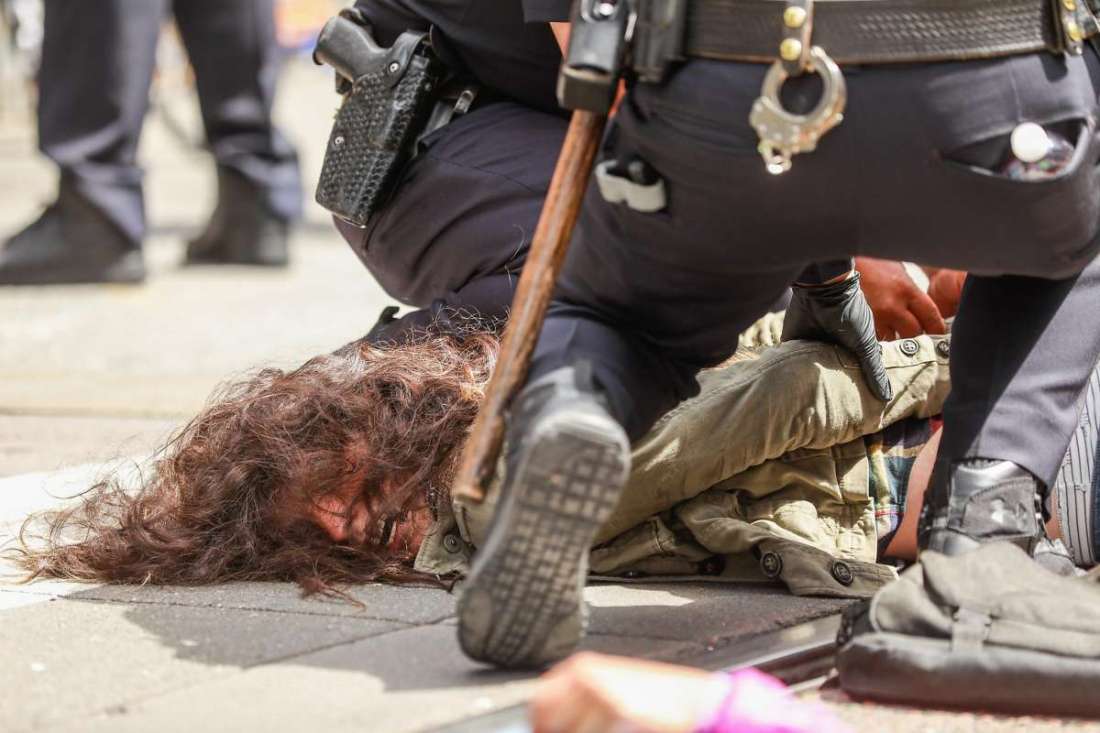
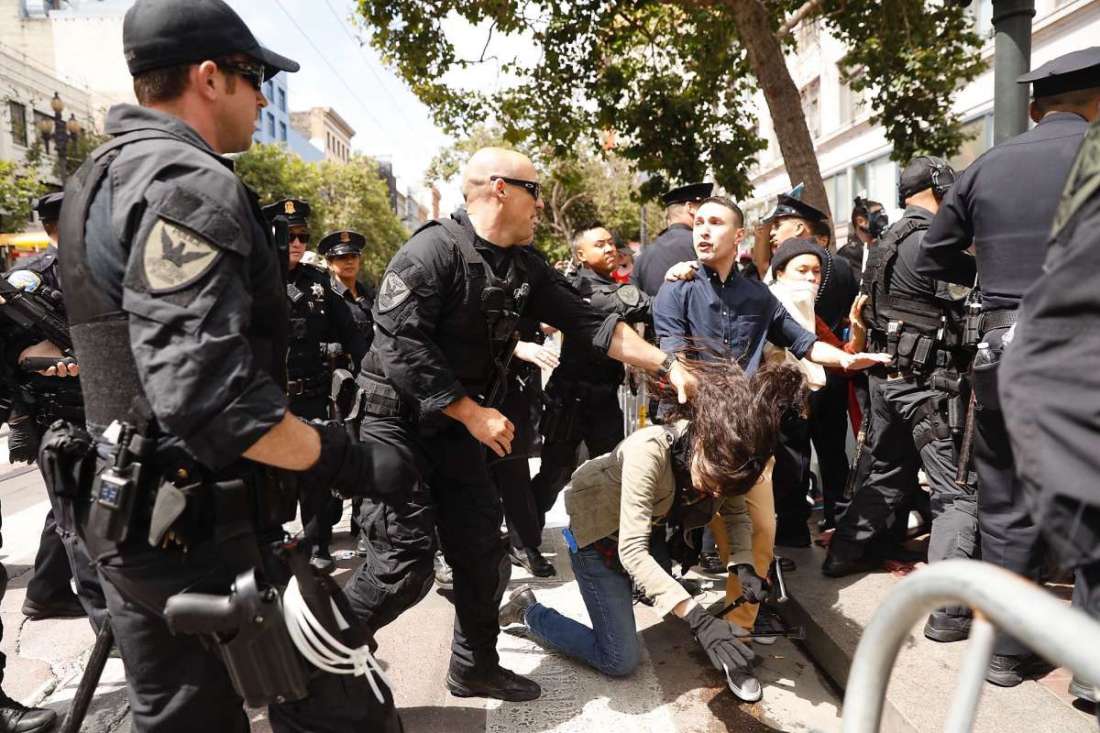
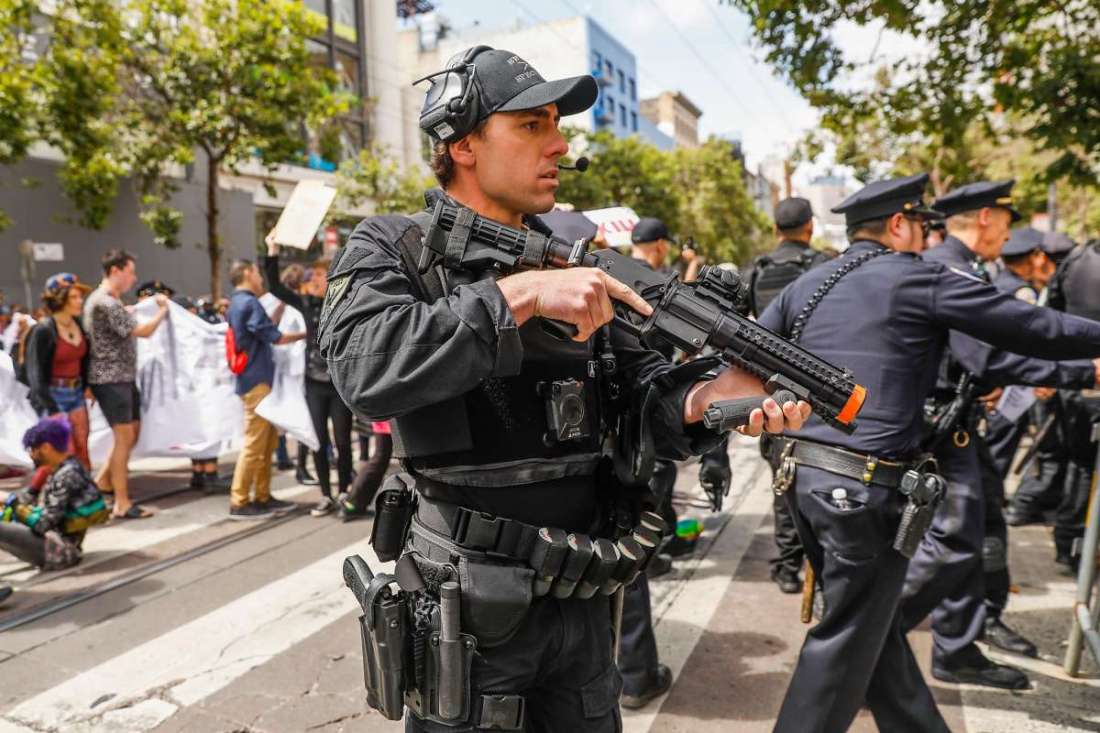
As if the sledgehammer wasn’t enough, Carmody said the officers drew their guns and handcuffed him — for six hours. Picture that. Being handcuffed in your own home and forced to look on as police seize your laptops, phones and notebooks, the ones containing work from your 29-year career.

Is the San Francisco Police Department acting like Keystone Cops and going to ridiculous lengths to show supporters of Adachi they take seriously that one of its officers leaked the details of his death? Or did the department intend to send a very serious, very scary message to journalists?

Imagine seeing this story pop up on your phone. Must have been in some small town in the South, right? One where everybody voted for Donald Trump and believes the president’s crazy rants about “fake news” and journalists being the “enemy of the people”?

Nope, it happened right here in supposedly progressive San Francisco. You know, the cosmopolitan city where we treasure our freedoms. When it suits us anyway. And the most troubling part? The fact that so many city officials were in on it — and so few have condemned it after the fact.

Two Superior Court judges — Victor Hwang and Gail Dekreon — signed off on the warrants. (Sources say Hwang has been telling people around town there’s “more to the story,” but nobody but Hwang seems to know what that is. A spokeswoman for the Superior Court said judges cannot comment, citing ethical rules.)

Two FBI agents were on hand during the raid, too. And Mayor London Breed, to whom Police Chief Bill Scott reports, issued a milquetoast statement that managed not to say much at all, other than that the Police Department “went through the appropriate legal process to request a search warrant.”

I’ve covered three mayors — four if you count the brief tenure of Mark Farrell last year — and their feelings about the press seemed to range from irritation to anger, depending on the day. But the First Amendment? You’d think they’d appreciate that.

Supervisor Sandra Fewer, who is married to a retired police officer, told the San Francisco Examiner that it’s “illegal to obtain a police report unless it has been officially released.” That’s false. It’s perfectly legal for a journalist to receive a leaked document, and it’s essential to our role of serving as government watchdogs.

Fewer later clarified: “The truth is, I am not a legal expert.” No kidding.

Despite so much support for the Police Department’s actions, I still — perhaps naively — expected some contrition from Scott when he explained the raid to the Police Commission Wednesday night. He’s a genial guy who doesn’t relish the limelight or political fights, and I figured he’d strike a conciliatory tone. Maybe even apologize.

Quite the contrary.

Scott doubled down on the whole sledgehammer-to-the-door operation. Even though the story had gone viral and rightly earned the scorn of First Amendment groups nationwide. Even though the raid pretty clearly violated California’s shield law, which protects journalists from having to give up their sources.

“We have to do our jobs and make sure reports are not released when they are not supposed to be released,” Scott said. “If there’s criminal activity that’s proven, we want to get to the bottom of that.”

And also: “We are committed to maintaining the public’s trust. The leak was a breach of the public trust, and I understand that and we’re investigating that leak fully, including allegations of misconduct, potentially by members of the San Francisco Police Department.”

How does taking a sledgehammer to a journalist’s door maintain the public’s trust? Why can’t Scott use his own detectives — you know, the ones charged with solving crimes — to figure out who on his staff leaked the report?

Asked about the chief’s statements, David Stevenson, a spokesman for the Police Department, sent a statement tripling down on them.

“The citizens and leaders of the city of San Francisco have demanded a complete and thorough investigation into this leak, and this action represents a step in the process of investigating a potential case of obstruction of justice, along with the illegal distribution of confidential police material,” he emailed.

One justification for this bizarre raid seems to be that nobody liked Carmody or the kind of journalism he practiced. I’ve never met him, but he seems either unknown or disliked by everybody I’ve talked to in journalism circles or at City Hall.

But the law protects everybody — that’s the whole point of a law. It doesn’t matter if you’re popular or powerful. If you’re a stringer who sells information to media outlets or a Pulitzer Prize winner. Attorneys say California’s shield law protects all journalists, including freelancers like Carmody.

Note that The Chronicle had the same leaked police report, though we didn’t get it from Carmody and we didn’t pay for it. Why didn’t the Police Department raid one of our homes and handcuff us? Would the police chief, Superior Court and mayor have been OK with that?

Kudos to two supervisors who have been among the few non-journalists to publicly call out the Police Department for its terrible behavior. Supervisor Aaron Peskin released a statement Wednesday slamming both the Police Department and the judges who gave the go-ahead to the raid.

“A free press is a fundamental pillar of our democracy and must be protected,” Peskin said. “The fact that the Superior Court nevertheless signed warrants authorizing police to conduct the raid on a journalist’s home and to confiscate their belongings boggles my mind.”

Supervisor Hillary Ronen said San Francisco progressives relish leaks from the Trump administration, which have been the basis for so many national stories putting the president in a negative light. But she added that means supporting local journalists’ rights to receive leaked information, too, even if it put Adachi, beloved by the city’s progressives, in a negative light.

“We cannot have it both ways,” Ronen said. “I am shocked that the judges in this case, the police chief, the mayor, that so many levels of government aren’t decrying this abuse of power. … Never in my wildest dreams did I think they would sledgehammer a journalist’s door and take all of his equipment. It’s an abuse of power, and I don’t know what’s going on here.”

You and me both, supervisor.


German parliament condemns ‘anti-Semitic’ BDS movement

The German Bundestag has passed a resolution describing the Boycott, Divestment, Sanctions campaign against Israel as anti-Semitic. Parliamentarians said some BDS slogans recalled Nazi propaganda.

Excerpted from The New York Times  and Deutsche Welle 5.17.2019

BERLIN — The German Parliament on Friday became the first in the European Union to pass a symbolic resolution that designates the Boycott, Divestment and Sanctions, or B.D.S., movement against Israel as anti-Semitic.

The nonbinding vote said the campaign to boycott Israeli products, along with the movement’s “Don’t Buy” stickers, recalled “the most terrible chapter in German history” and revived memories of the Nazi motto “Don’t buy from Jews.”

“The pattern of argument and methods of the B.D.S. movement are anti-Semitic,” the resolution stated, vowing not to fund any organizations that question Israel’s right to exist, call for a boycott of Israel or actively support B.D.S.


The resolution, which mentioned “growing unease” in the German Jewish community as anti-Semitism has increased, was brought to Parliament by Chancellor Angela Merkel’s conservative Christian Democratic Union party and its Social Democratic coalition partner, as well as the liberal party and the Greens.

Crime statistics published by the German Interior Ministry on Tuesday showed that anti-Semitic crime and hate crime rose by 20 percent last year. The report found that nine in 10 anti-Semitic offenses were committed by people on the far-right.

The Palestinian B.D.S. National Committee said in a statement Friday that it “rejects all forms of racism, including anti-Semitism” and condemned what it called an “anti-Palestinian, McCarthyite and unconstitutional resolution passed by the German Parliament.”

BDS III 5.19.2019.jpg

“We call on people of conscience in Germany and beyond to defend the sanctity of universal human rights and freedom of expression by protecting the right to B.D.S.,” the statement read. “The academic and cultural boycott of Israel is strictly institutional and does not target individual Israelis.”

There were other critics, too. Some 60 academics signed an open letter, saying the motion formed part of a worrying trend of “labeling supporters of Palestinian human rights as anti-Semitic.”

But Prime Minister Benjamin Netanyahu of Israel congratulated Parliament, known as the Bundestag, on its “important decision to recognize B.D.S. as an anti-Semitic movement and that it is forbidden to support it.”

“I particularly appreciate the Bundestag’s call on Germany to stop funding organizations that work against the existence of the State of Israel,” Mr. Netanyahu said, “I hope this decision will lead to concrete action, and I call on other countries to adopt similar legislation.”

Germany’s Jewish organizations  welcomed the vote.

Link to Deutsche Welle article

https://www.dw.com/en/german-parliament-condemns-anti-semitic-bds-movement/a-48779516

Link to New York Times article

https://www.nytimes.com/2019/05/17/world/europe/germany-bds-anti-semitic.html


‘The Lost Metropolis’: 1930s Tokyo street life – in pictures

Every Picture Tells a Story – Ongoing Series

The Guardian – May 17, 2019

Kineo Kuwabara captured these rich images of everyday life the city during the buildup to the second world war. The series is on display 18-19 May at the Special Edition of The London Photograph Fair

Tokyo Street Life III 5.17.2019

Tokyo Street Life I 5.17.2019.jpg

Tokyo Street Life IV 5.17.2019.jpg

https://www.theguardian.com/cities/gallery/2019/may/17/the-lost-metropolis-1930s-tokyo-street-life-kineo-kuwabara-in-pictures

German Cookie Heiress downplays forced labor use during Holocaust

Excerpted from Deutsche Welle 5.15.2019

The Bahlsen biscuit empire heiress sparked outrage after claiming forced workers were “well-treated” during World War II. Despite her apologies, the case has reignited debate over Germany’s remembrance culture.

According to Verena Bahlsen, forced laborers were treated “well,” since they were paid the same wages as their German counterparts. The heiress made clear she refused to assume responsibility for something she had not actively taken part in and that happened before her time.

Arbeits Macht Frei  II 5.15.2019.jpg

This caused an uproar worldwide, and especially in Germany, where commemorative culture is a highly sensitive issue. General Secretary of the social democrats (SPD) Lars Klingbeil declared:

“Those who inherit such a large fortune also inherit the responsibility that goes with it and shouldn’t appear so detached. It is no wonder that people lose faith in justice, when millionaires talk about yachts and not about responsibility.”

It all started at a business conference earlier this week: Verena Bahlsen, the 25-year-old heiress to the eponymous cookie manufacturer, attended a marketing conference at which she boasted about her riches. All she wanted was “to make money and buy yachts with [her] dividends,” she told the audience.

Little did she know that her unabashed claims to millionaire’s privileges would make her Germany’s most controversial character this week. Her comments came as a slight for dozens of families awaiting compensation after their ancestors were forced to work for the Bahlsen corporation during World War II.

WWII forced labor widespread

Forced labor in Germany, and within the Bahlsen family’s factory in particular, didn’t come as a surprise: During the Nazi era, an estimated 13 million people were coerced to work for the Third Reich. Forced laborers included displaced civilians — men, women and children — from occupied Europe, prisoners of war and concentration camp prisoners.

Verena Bahlsen (picture-alliance/dpa/M. Skolimowska)Verena Bahlsen, heiress to the Bahlsen factory empire


In 2000, some 60 Eastern European individuals who had performed forced labor for the company filed a lawsuit against Bahlsen. Between 1941 and 1945, it is believed that up to 200 people, mostly Ukrainian women, were forced to work in Bahlsen’s Hannover factory.

Their compensation claims were rejected as the Court dismissed the case, but the cookie manufacturer partly redeemed itself on the public scene by joining a charity aimed at giving reparations to the victims of Nazi-era forced labor. Bahlsen paid more than 1.5 million Deutschmarks (about €767,000, $859,500) to the plaintiffs and the case seemed shelved until Monday, when the heiress sought to justify her stance by downplaying the company’s wartime activities.

https://www.dw.com/en/heiress-downplays-factorys-forced-labor-use-during-holocaust/a-48749795

SF Mayor: Tepid response to police abuse, mistreatment of journalist

Search  widely criticized as a violation of press freedom.

The Examiner has done very solid reporting on this threat to all journalists. It is,no doubt about it, an assault on the free press.  For this to happen in Progressive San Francisco makes it all the more disturbing.

Excerpted from San Francisco Examiner 5.14.2019

As San Francisco police face backlash from across the nation for raiding the home and office of a freelance journalist, Mayor London Breed on Tuesday declined to condemn the action.

Referring to the search warrants police obtained against freelancer Bryan Carmody last week, the mayor said in a statement that the department “went through the appropriate legal process to request a search warrant, which was approved by two judges.”

No cameras allowed 5.14.2019.jpg

“I believe that someone from within the department needs to be held accountable for the release of this information,” Breed said. “The police need to continue that internal investigation using legal and appropriate means.”

Questions remain about the reasons judges Victor Hwang and Gail Dekreon had for issuing the warrants. A court spokesperson has declined to comment, and neither judge has publicly explained their reasoning.

Police executed the search warrants Friday as part of an investigation into the leak of a police report on the death of the late Public Defender Jeff Adachi. The department is facing political pressure to find the source of the leak as the report included scandalous details about his death.

Breed made her comments despite an outcry from journalists and civil liberties attorneys who say the warrants may have violated federal and state laws that protect journalists from having warrants issued against them.

Her statement comes on the same day that an attorney for Carmody decided to move forward with legal action after the department missed a noon deadline for agreeing to return the items investigators seized from Carmody.

Tom Burke, an attorney for Carmody, said he would file a motion before each judge seeking to invalidate the warrants and have the seized items returned to Carmody without being reviewed by police. The items included reporting notebooks, video cameras and computers that Carmody used for newsgathering.

https://www.sfexaminer.com/the-city/mayor-breed-walks-the-line-in-response-to-police-raid-on-journalists-home/


San Francisco Police Raid on Journalist Alarms Free Press Advocates

Police Power in San Francisco:  Harassment, physical abuse and detention of a journalist is getting the public hearing it deserves.  The San Francisco Chronicle has a pointed editorial about this outrage in its May 14, 2019 edition.

New York Times 5.13.2019

SAN FRANCISCO — When two San Francisco police officers knocked on Bryan Carmody’s door in April they politely requested that Mr. Carmody, a freelance videographer, reveal who had leaked a police report to him about the mysterious death of the city’s public defender.

“They were nice about it,” Mr. Carmody said. “Of course I said, ‘No, I’m not going to tell you guys.’”

But when a dozen officers returned to his home on Friday, this time their guns were drawn and they came equipped with a search warrant, a sledgehammer and a battering ram.

Adachi Press Attack II 5.14.2019

In an interview Monday, as concern spread among journalists and civil rights activists about his treatment, Mr. Carmody said his wrists were still sore from being handcuffed for six hours while the police raided his house and seized laptops, phones and hard drives — including all the images and documents he had archived from his 29-year career as a reporter and cameraman.

“I said, ‘Why didn’t you guys just knock?’” Mr. Carmody, 49, said. “My biggest concern is to get my equipment back.”

Mr. Carmody’s lawyer, Thomas Burke, said Monday that he would pursue legal action against the San Francisco Police Department, requesting that all the equipment be returned to his client.

“Part of the reason there has been such a reaction to this,” Mr. Burke said, “is that you don’t want it to become the norm that when law enforcement wants information they send 10 guys with a sledgehammer and guns to get it.”

The raid has raised alarm among free press advocates who question why two trial court judges allowed a search for communication about the leaked document, which was described in the search warrant as “stolen or embezzled” property. Free speech advocates have also questioned why two F.B.I. agents were present during the raid.

The Police Department did not return calls about the investigation. A spokeswoman in the F.B.I.’s San Francisco office confirmed the agents’ presence but declined to say how they were involved.

“The seizure and search of the guy’s home and office were totally inappropriate and out of bounds,” said Matt Drange, the co-chair of the freedom of information committee of the Northern California chapter of the Society of Professional Journalists. “Publishing a leaked document is not breaking the law.”

The case stems from the death in February of Jeff Adachi, the city’s public defender, who was beloved by San Francisco’s liberal elites but who had a contentious relationship with the Police Department.

Mr. Carmody obtained a police report soon after Mr. Adachi’s death that said the public defender collapsed in an apartment with a woman who was not his wife. Supporters of Mr. Adachi said they suspected that the Police Department had leaked the report to tarnish the reputation of its longtime adversary: Mr. Adachi had campaigned against police abuses, including a scandal involving racist text messages among officers. Confronted with the subsequent outrage, the police started an investigation into the leak.

An autopsy released a month after his death revealed that Mr. Adachi, 59, died from a mixture of cocaine, alcohol and a weakened heart. The female friend had called 911 after Mr. Adachi collapsed in a loaned apartment.

The public defender’s office initially offered strong support for the police raid on Mr. Carmody’s house. Manohar Raju, who took over from Mr. Adachi, issued a statement to a San Francisco Chronicle reporter that repeated criticism of the leak and praised the police for “working to get to the bottom of it.”

On Monday, Mr. Raju seemed to walk back some of his support.

“Nothing about my statements should be interpreted as condoning specific police actions or tactics,” Mr. Raju said in a new statement.

Mr. Adachi’s supporters say they have been dismayed by the release of the personal information surrounding his death, kindling a debate about the line between public and private details of a prominent person.


Outrage over the leaked report was channeled into a hearing last month by the San Francisco board of supervisors, at which senior police officials were asked to explain how it happened. One supervisor, Hillary Ronen, called it a politically motivated attack. Mr. Adachi’s widow, Mutsuko Adachi, who attended the hearing, described it as “despicable.”

Mr. Carmody said the police report was crucial to understanding an unexpected death of an important city official. Initially reporters had been told that Mr. Adachi had died while “on the road” for work.

The public defender’s office, without offering evidence, has suggested that the police report was sold to the news media. Mr. Carmody denied paying anyone for the report; so did The Chronicle, which obtained the report separately.

Mr. Carmody’s job as a freelancer is to gather information and footage and then sell the produced stories to his clients, mainly national and Bay Area television stations. In the case of Mr. Adachi’s death, he said, the story he sold included footage, interviews and the police report.

Police departments in California have wide discretion over when to release police reports but in the case of Mr. Adachi it was leaked anonymously.

Mr. Raju of the public defender’s office said he believed that police reports should remain confidential unless they expose government abuse or illegal conduct.

“Certainly they should not be released to satisfy curiosity, embarrass any parties or as revenge against those who have questioned conduct by particular police officers,” Mr. Raju said.

California offers strong protections for journalists who choose not to reveal confidential sources. A central question in Mr. Carmody’s case is whether the authorities violated those laws and whether the judges who signed the warrants were aware that Mr. Carmody was a journalist.

Mr. Carmody said he did not want to get involved in the politics of the issue, and a friend has started an online campaign to help finance the replacement of his equipment.

“My goal right now is to get my business up and running,” he said. “Believe me, no one is getting rich being a freelance videographer in San Francisco.”

Unreal: Navy Seal’s lawyers received emails embedded with tracking software

Huh??? Who needs to read fiction?  What’s that old saying, “Life imitates Art.”

The Guardian 5.13.2019

Military prosecutors in the case of a US navy Seal charged with killing an Islamic State prisoner in Iraq in 2017 installed tracking software in emails sent to defense lawyers and a reporter in an apparent attempt to discover who was leaking information to the media, according to lawyers who said they received the corrupted messages.

“I’ve seen some crazy stuff but for a case like this it’s complete insanity,” said attorney Timothy Parlatore. “I was absolutely stunned, especially given the fact that it’s so clear the government has been the one doing the leaking.”

Parlatore represents Edward Gallagher (pictured below), the special operations chief who has pleaded not guilty to a murder count in the death of an injured teenage militant he allegedly stabbed to death in Iraq in 2017. Gallagher’s platoon commander, Lt Jacob Portier, is fighting charges of conduct unbecoming an officer for allegedly conducting Gallagher’s re-enlistment ceremony next to the corpse.

Navy Seal II 5.13.2019

“In this case, discovery of the requested items is important to ensuring the prosecution in this case did not take any part in arranging or permitting an intrusion into Lt Portier’s attorney-client relationship.”

The prosecutor, Christopher Czaplak, declined to comment. Navy spokesman Brian O’Rourke did not immediately return a phone message seeking comment.

The emails were sent last Wednesday to 13 lawyers and paralegals and to Carl Prine, a reporter for the Navy Times newspaper. Prine has reported extensively on the case and has broken several stories based on documents provided by sources.

While documents are subject to a court order not to be shared, none has been classified, Prine said.

The tracking software was discovered almost immediately by defense lawyers who noticed an unusual logo of an American flag with a bald eagle perched on the scales of justice beneath the signature of Czaplak. It was not an official government logo.

Parlatore said suspicious tracking software was embedded in the logo. He contacted Czaplak to make sure his email had not been hacked.

“I can’t imagine you’d be trying to track defense attorneys’ emails,” Parlatore said he told Czaplak. “I want to make sure your system hasn’t been compromised.”

The defense lawyers want to know if the software recorded where and when they opened an email message and who they may have forwarded it to – or if it installed malware on their computers and possibly gave prosecutors access to other files.

Gary Solis, who teaches law at Georgetown and as a US marine corps lawyer prosecuted 400 cases and was a judge on more than 300 others, said he had never heard of hidden cyber tracking software sent to defense lawyers by prosecutors.

“Not only is it ethically questionable, it may be legally questionable,” Solis said. “When it’s apparently so easily discoverable when done in an ineffectively haphazard manner it’s more than ethically questionable, it’s questionable on an intellectual level.”

https://www.theguardian.com/us-news/2019/may/13/navy-seals-lawyers-received-emails-embedded-with-tracking-software