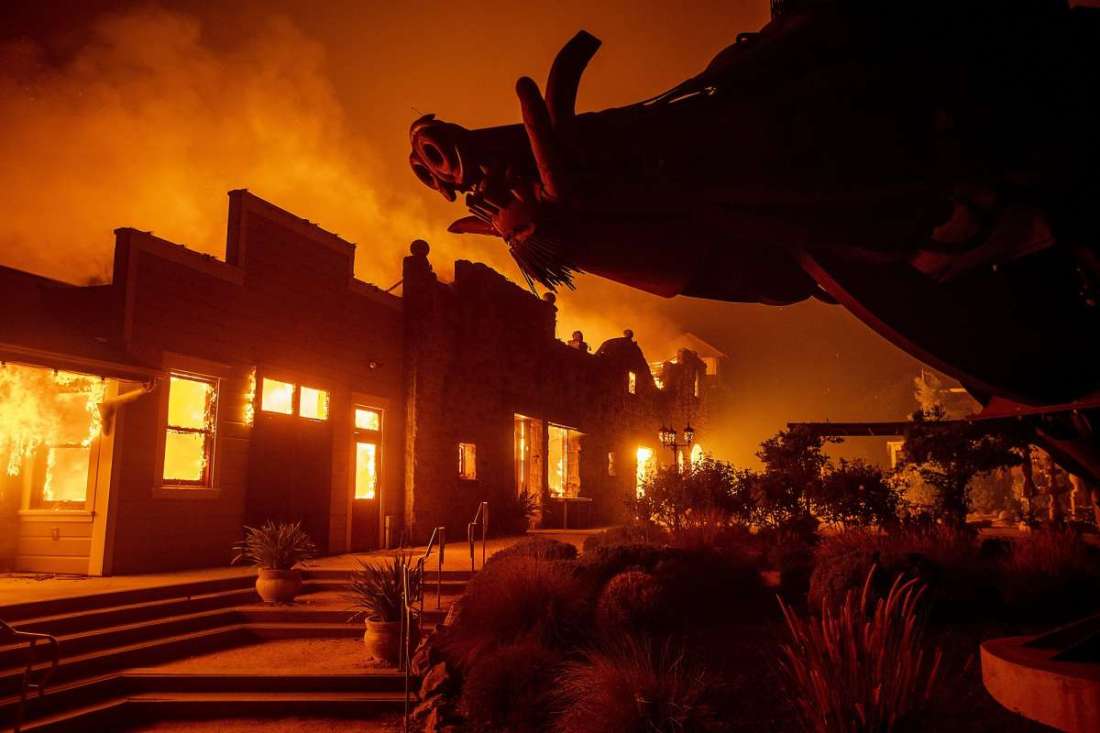
PG&E helped fund career of California governor he accuses of ‘corporate greed.’

California Governor Gavin Newsom came down hard on California’s beleagured PG&E utility earlier today when he rejected its latest plan to exit bankruptcy. (see attached link)

https://www.sfchronicle.com/california-wildfires/article/Gov-Newsom-rejects-PG-E-s-reorganization-plan-14906105.php

The following article from the Washington Post, far away from Newsom’s home base is illustrative of the cozy relationship between public utilities and the politicians who oversee them.

Is this an example of biting the hand which feeds you?

Washington Post 11.13.2019

California Gov. Gavin Newsom has accused his state’s largest utility company of mismanaging funds he said it should have used to upgrade an aging electrical grid prone to deadly wildfires.

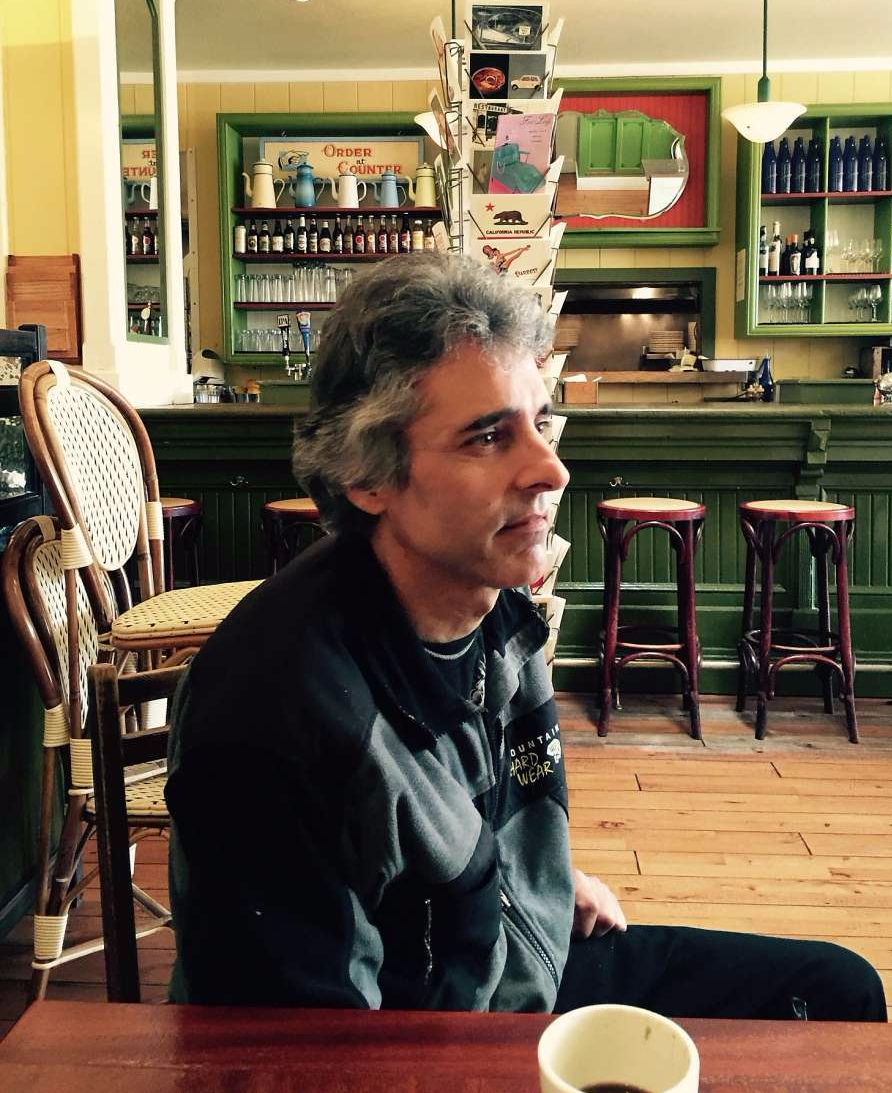
But over the past two decades, Newsom, a Democrat, (shown below) and his wife have accepted more than $700,000 from the Pacific Gas & Electric Co., its foundation and its employees as the utility has supported his political campaigns, his ballot initiatives, his inauguration festivities and his wife’s foundation, including her film projects, according to records reviewed by The Washington Post.

PG&E Bankruptcy IV 12.13.2019.jpg

The contributions illustrate Newsom’s ties to the company responsible for wildfires that have killed at least 85 people and caused billions of dollars in damage over the past three years. The governor has slammed PG&E for paying bonuses to executives and cash dividends to its investors instead of spending more on infrastructure upgrades that could have prevented the fires.

“As it relates to PG&E, it’s about dog-eats-dog capitalism meeting climate change,” Newsom said at a news conference last month. “It’s about corporate greed meeting climate change. It’s about decades of mismanagement. It’s about focusing on shareholders and dividends over you and members of the public.”

He added that he while can forgive the company for not predicting the degree of impact climate change has had on California, “I will not forgive them for not making the kind of investments in their equipment – hardening and undergrounding and anticipating this new reality of which they have had ample time to anticipate.”

Records show PG&E has spent at least $227,000 on Newsom’s political campaigns and committees supporting them over his two decades in public office, helping to fund his rise from San Francisco mayor to one of the country’s most influential Democratic leaders. PG&E employees have spent an additional $70,000 on his campaigns. The company gave $25,000 for his mayoral inaugural costs and $25,000 to city ballot measures that he supported.

Between 2011 and 2018, the utility’s philanthropic arm gave $358,000 to the Representation Project, a nonprofit group founded by Jennifer Siebel Newsom, the governor’s wife. The PG&E Corporation Foundation also gave $10,000 to the PlumpJack Foundation, a charity led by his sister, Hilary Newsom, according to information provided by PG&E.

The company gave enough money to be listed as an associate producer in the credits for two of Jennifer Siebel Newsom’s documentary films. It also hosted high-profile screenings of the films at its offices, including in the atrium of its San Francisco skyscraper in 2011.

The payments are not unusual for PG&E, one of the most politically active companies in California state and local politics and a prolific contributor to Bay Area charities. PG&E spent $5.3 million on state and local political campaigns in 2017 and 2018, the company said in a court filing this year, with Newsom receiving more of that money than any other single candidate.

PG&E’s political and philanthropic spending, along with executive compensation and shareholder payouts, are determined by the holding company PG&E Corp. Its subsidiary, the PG&E Co., is a regulated monopoly that must negotiate its revenue and expenses with state regulators every three years.

Still, the money PG&E contributed to the campaigns of Newsom and other politicians could have been used to put power lines underground or clear brush that leads to wildfires, said David Pomerantz, executive director of the Energy and Policy Institute, a San Francisco-based utilities watchdog.

PG&E Bankruptcy III 12.13.2019.jpg

“Every dollar that PG&E spends on a campaign contribution right now is one they should be spending to hasten the transition to a safer, more distributed electrical grid,” Pomerantz said.

PG&E, an investor-owned utility whose largest shareholders include hedge funds Knighthead Capital Management and Abrams Capital Management, filed for bankruptcy in January, declaring itself unable to pay the billions of dollars in mounting liabilities from repeated seasons of wildfires. Its market value is about $3.4 billion, after losing more than $30 billion in equity value over the past two years.

When a federal judge asked PG&E in July to explain why its political spending was “more important than replacing or repairing the aging transmission lines,” the company said it needs to make the concerns of its employees, customers and shareholders known to policymakers.

“Like many individuals and businesses, PG&E participates in the political process,” Ari Vanrenen, a spokeswoman for the company, said in an emailed statement. “PG&E holds itself to the highest standards of public disclosure and compliance with applicable laws and regulations.”

Vanrenen said the utility has invested $27 billion in its electric system over the past decade, including $3 billion in vegetation management and tree trimming. The company is actively moving some of its power lines underground, but PG&E estimates that process costs about $3 million per mile, or more than three times the cost of building overhead lines. By that estimate, converting all 18,000 miles of its overhead lines to underground lines would cost more than $50 billion.

Gov. Newsom declined a request to be interviewed. When asked about PG&E’s campaign contributions at a news conference earlier this month, he said the money has never affected his decisions in office.

“If the suggestion is that somehow I am influenced by that, you’re wrong,” Newsom told a reporter from Sacramento news channel ABC10. “There’s not one thing you can point to during my tenure as governor.”

Nathan Click, a spokesman for Newsom, said in an emailed statement that the governor has “used every tool at his disposal” to hold PG&E accountable, including passing a law that he said created new safety requirements for PG&E if it wants to access a state wildfire relief fund.

PG&E Bankruptcy I 12.13.2019

Click said Newsom stopped taking contributions from PG&E after his election in November 2018. There is no record of the company contributing to his inaugural events or future gubernatorial campaign since then. Still, a week after the election, his wife’s Representation Project held its annual gala at San Francisco’s historic Ferry Building and listed PG&E as a main sponsor.

Caroline Hellman, executive director of the nonprofit, told The Post in an email that the organization stopped taking donations from PG&E “upon Gov. Newsom taking office,” which happened in January.

In interviews, Nathan Ballard and Steve Kawa, two of Newsom’s former advisers, said the politician never gave PG&E any special treatment. Kawa pointed to Newsom’s effort as lieutenant governor to pressure the company to close its Diablo Canyon nuclear power plant, which PG&E petitioned to keep active despite concerns it is vulnerable to earthquakes.

“It is impossible to curry favor with Gavin Newsom,” said Ballard, a longtime Newsom friend and communications adviser. “He has a very strong sense of right and wrong, and he has a long track record of voting against his closest allies and making policy decisions that displease his closest allies.”

Ballard is on the board of Jennifer Siebel Newsom’s nonprofit. PG&E is a client of his public relations firm.

PG&E was despised by many Californians long before the recent wildfires. Cast as the villain of “Erin Brockovich,” the Oscar-winning 2000 film based on a true story about PG&E’s role in contaminating the water supply in a small California town in the 1990s, PG&E has also been blamed for exploding manholes covers, accused of falsifying safety records and criticized for charging some of the highest electricity rates in the country.

Some public officials have distanced themselves from PG&E by returning or donating funds they received from the utility.

Gov. Jerry Brown, a Democrat and Newsom’s predecessor, returned $9,000 to PG&E in 2017 after the utility was convicted of six federal felonies for failing to prevent a pipeline explosion that killed eight people and destroyed 38 homes in San Bruno in 2010. Filings show that PG&E gave Brown and committees supporting him more than $300,000 for his statewide campaigns.

Timothy Grayson, a Democrat and state assembly member for Contra Costa County, said he donated the $6,500 he received from PG&E to his local United Way charity after meeting with constituents who had lost their homes to last year’s wildfires.

“When we saw the pain on their faces, the tears in their eyes and the brokenness of having lost everything, there was no doubt in my mind that the right thing to do was to take the money from those who were responsible for the fire and give it to those who were most impacted by the fire,” Grayson said.

RL Miller, the chair of the California Democratic Party’s environmental caucus, said Newsom should return the funds he has taken from PG&E.

“Doing so will show that he’s committed to genuine reform,” Miller said in an email.

Newsom’s spokesman declined to comment on whether the governor would consider returning any funds.

– – –

As mayor of San Francisco from 2003 to 2010, Newsom became a rising star in California politics. Corporations such as PG&E that were seeking city contracts were banned from contributing to local political campaigns but found other ways to show their support.

As Newsom faced off against eight other candidates in his first run for mayor, he had championed two city ballot measures – a ban on aggressive panhandling and an overhaul of the city’s welfare program – that helped raise his profile and put him over the top in the race. The utility chipped in $15,000 to support the efforts, campaign finance records show, and later gave $10,000 to support a measure he backed for citywide WiFi.

PG&E’s foundation was also among the largest donors to both of Newsom’s mayoral inaugurals, giving a total of $25,000, city records show.

John Avalos, who later served on the city’s Board of Supervisors, said that in those years, PG&E was the biggest player in city politics and philanthropy, because the technology sector was still young.

“You couldn’t be mayor in San Francisco without having the backing of PG&E,” Avalos said. “They were like the anchor, the one percent – the rich and powerful that determine the outcome of elections.”

The company’s equipment repeatedly raised concerns about public safety. In 2005, an underground equipment failure in the city’s financial district led to an explosion that burned a woman, set fire to a Polo Ralph Lauren store and forced several square blocks to close.

“If this happens again, PG&E is in real trouble,” Newsom told the San Francisco Chronicle at the time.

The utility continued to support Newsom as he clashed with the more liberal wing of California’s Democratic Party. When some called for San Francisco to take over its own electrical power grid – a ballot measure supported by eight of 11 district supervisors – Newsom sided with PG&E’s campaign to oppose it. Newsom told the Chronicle at the time that there was “no groundswell” of city residents calling for a takeover of the power grid.

The company spent more than $10 million to defeat the proposition and hired a consultant, Eric Jaye, who was also Newsom’s longtime friend and political adviser. The measure failed. Jaye declined to comment for this report.

As Newsom’s profile continued to rise, the utility made sure to follow. The mayor made one of his first big appearances on the national stage when he hosted a Democratic National Convention party in Denver in 2008. Called “Unconventional 08,” it was described by one media outlet as “hundreds of sweaty hipsters dancing in an art gallery.” The event, sponsored by PG&E, featured comedian Sarah Silverman and the indie band Cold War Kids.

Two years later, a natural-gas pipeline owned by the utility exploded into flames in a residential neighborhood called Crestmoor in San Bruno. Eight people died, and an entire block was destroyed. Authorities blamed the explosion on the company’s failure to properly maintain its gas lines.

California regulators determined that in the years before the fire, PG&E had taken in revenue of hundreds of millions more dollars than was authorized by the state and that it had significantly underspent on maintenance and infrastructure needs.

Regulators wrote in their report that “dividends, stock repurchases, bonuses, and image were of greater importance to management.” In the years before the disaster, they pointed out, PG&E paid its investors $2.5 billion in cash dividends and set aside more than $150 million for incentive pay to top executives.

In response, PG&E submitted a report conducted by an outside management consultant, who said that the California Public Utilities Commission report had been based on incorrect assumptions and that PG&E had actually overspent on maintenance and capital expenditures.

Jerry Hill, who represents San Bruno in California’s state Senate, said that he stopped taking donations from the utility after the explosion and that appearing at fundraisers with the company’s executives fell out of favor.

“I don’t think there is any love for PG&E in the legislature, even after they have made those millions of dollars in contributions,” Hill said.

– – –

When Newsom was elected lieutenant governor in 2010, his wife’s career had begun to take off.

Jennifer Siebel Newsom’s documentary “Miss Representation,” examining how women are portrayed in media, premiered at the Sundance Film Festival in 2011. Four years later, she premiered “The Mask You Live In” there.

Both films list “Pacific Gas & Electric Company” as an associate producer. It is not clear how much the utility gave to support “Miss Representation,” but tax returns for its foundation report a $25,000 donation for “The Mask You Live In.”

As Gavin Newsom neared a gubernatorial campaign, the foundation upped its financial support to his wife’s causes.

Between 2011 and 2018, PG&E’s foundation gave $358,000 to the Representation Project, the nonprofit associated with Jennifer Newsom’s film production, according to tax records and a list provided by PG&E. That is about 4 percent of the $8.6 million the nonprofit reported in contributions and grants during that time period.

Tax records show Jennifer Newsom earned $150,000 for her work at the nonprofit in 2017.

In 2017, PG&E executive Brandon Hernandez joined the board of the Representation Project, the tax records show. He attended its annual gala as a “champion sponsor,” which required a donation of $25,000. Records indicate he left the board after that year. In an email, he said he is no longer employed by PG&E.

Gavin Newsom’s gubernatorial campaign raised more money from PG&E – $270,000 – than any of his previous campaigns. But becoming governor forced him to confront the company’s problems, which were beginning to grow into a statewide crisis.

Just two days after the November 2018 election, a PG&E transmission line fell and sparked the Camp Fire, the deadliest and most destructive blaze in California’s history. Two months later, PG&E filed for bankruptcy.

The governor shepherded a bill through California’s legislature that created a $21 billion state fund from which PG&E and other utility companies could pay claims to victims of future wildfires. The law required companies to meet spending targets on safety initiatives and gave PG&E a deadline for exiting bankruptcy if it wanted to access the funds: June 30, 2020.

Newsom escalated his public criticism of PG&E last month, when the company shut off power to millions of residents in an attempt to prevent more fires. In a terse news conference on Nov. 1, Newsom threatened a public takeover of the company if it does not find a way out of its bankruptcy.

“PG&E as we know it may or may not be able to figure this out,” Newsom said at the event. “If they don’t, we are not going to sit around and be passive.”

https://www.sfchronicle.com/business/article/PG-E-helped-fund-the-careers-of-California-14826790.php

Video reveals San Francisco police shot man while he was running away

The SFPD shooting of Jamaica Hampton is a sad but all too common episode.  The fact SFPD fired eight shots and him Hampton three times has all but disapeered from the mainstream San Francisco Media.

As of Wednesday Hampton was still hopitalized in critical condition.

It is the community news outlets which are keeping this latest tale of SFPD behavior alive.

Mission Local 12.11.2019 – By  and 

A San Francisco town hall meeting regarding last weekend’s Mission District shooting by SFPD  will be held at 6 p.m. on Tuesday, Dec. 17, at Cesar Chavez Elementary School, at 825 Shotwell St., between 21st and 22nd.

Video of Saturday morning’s police shooting of Jamaica Hampton reviewed extensively by Mission Local reveals the 24-year-old was not shot while purportedly assaulting an officer — but rather, while attempting to escape a pair of them. Hampton was shot, at least once, while running from one officer and in the direction of another, following an extended foot chase. 

He was hit in what appeared to be his front left midsection or upper leg about a minute into the video clip, and collapsed into the middle of 23rd Street. A clutch of San Francisco Police Department officers subsequently stripped his clothing and applied resuscitation efforts as blood pooled on the double yellow lines.

While Mission Local was able to review the footage thoroughly, we were unable to obtain permission to publish it online.

In the video, Hampton appeared to be holding an object in his hand — potentially the bottle with which he allegedly struck an officer moments before. That alleged attack is not caught on the footage observed by Mission Local.

Rather, it begins with a pair of officers running, guns drawn, eastbound on 23rd Street, attempting to contain the fleeing Hampton. He bobs and weaves between parked cars and runs about the sidewalks and the streets in an effort to elude the officers — who have their guns drawn throughout. At several points, Hampton ceases running, and both officers take aim at him and have a clear line of fire. Since there is no sound in the video, it is unclear what directions the officers were giving to Hampton. But, rather than surrender, he would then break off running again.

In the pivotal sequence, he sprints off the sidewalk on the south side of 23rd, past an SUV, and past one officer. He then heads onto the opposite sidewalk on the north of the street and begins running west, toward Mission Street — before abruptly cutting between two parked cars and darting into the street.

At this point he is running in the direction of the second officer, who was standing in the middle of 23rd Street — though, it appears, not directly at him. That officer fires at least once at Hampton, from a range of perhaps six to eight feet and what looks to be a 45-degree angle from the running suspect. 

Hampton doubles over and hits the ground. He appears to attempt to get up, but he cannot.

Eyewitness accounts following the 8:33 a.m. Saturday incident reported an officer with a bloody face and what appeared to be a broken nose, and the SFPD confirmed an officer was hospitalized along with Hampton.

The  Dec. 7 incident was the city’s first police shooting in 2019 and, in fact, its first since June 2018.

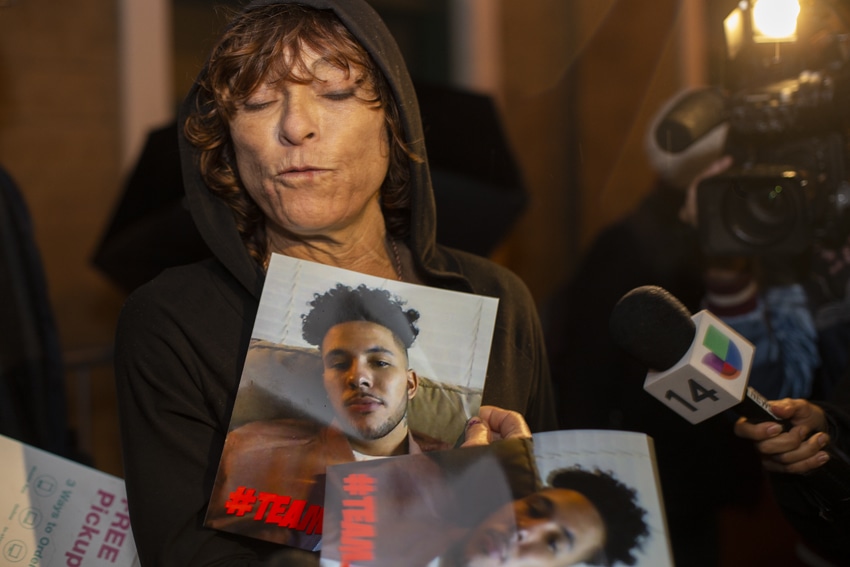
At a Tuesday night demonstration in front of Mission Police Station, Mission District activists were surprised when Hampton’s mother, Tana, unexpectedly showed up and asked organizers to address the crowd. Tana Hampton, who had made the trip to the city from Sacramento, identified the shooting victim as her son. The SFPD confirmed on Wednesday in a press release that Jamaica Hampton was the man involved in the Saturday incident. He was approached by police responding to a suspected burglary and then allegedly assaulted an officer before “an officer-involved shooting occurred,” according to the press release. 

Hampton had struggled with substance abuse. Family spokeswoman Dyne Biancardi said he’d relocated to the city from Sacramento for a treatment program. Jamaica Hampton had been homeless “for a while,” according to Biancardi.

Wednesday’s SFPD press release announced that Hampton had been booked on the charges of assault with a deadly weapon other than a firearm (two counts), battery with injury on a peace officer (two counts), battery resulting in serious injury (two counts), and obstructing or resisting an “executive officer” in the performance of duties, by use of threats, force of violence (two counts).

Biancardi lives a few blocks away from where the shooting occurred. She told reporters she was initially contacted by Jamaica Hampton’s brother. She then waited outside of Jamaica Hampton’s hospital room for five hours, she said. Biancardi, who is also a lawyer, said the Jamaica Hampton had been shot in the leg and that it was unlikely he would be able to walk the same way again.

Hampton’s sister, Brittany, told Mission Local that the family’s attempts to visit Hampton in the hospital were barred by sheriff’s deputies, who said they were acting on the orders of the District Attorney. Our calls to the DA have not been returned.

The Hampton family hopes to visit Jamaica Hampton this afternoon.

Above: Jamaica Hampton’s interview with CityTeam, a nonprofit. The video was published on Oct. 29, 2019 via Youtube.

A medical worker told media gathered Wednesday morning at San Francisco General Hospital that Hampton had been shot three times in his legs. SFPD officers purportedly shot at Hampton eight total times.

Brittany Hampton told Mission Local that the SFPD contacted her and said no charges would be filed against her brother. SFPD spokesman Sgt. Michael Andraychak, however, denied that any charges had been dropped. “The press release is accurate,” he said.

https://missionlocal.org/2019/12/video-reveals-police-shot-jamaica-hampton-while-he-was-running-not-while-he-was-allegedly-assaulting-officer/


Giant ferris wheel to spin in Golden Gate Park to celebrate 150th anniversary

WHAT NEXT?????

THE 150 FOOT HIGH FERRIS WHEEL WOULD BE BETTER POSITIONED AT THE BEACH CHALET SOCCER FIELD..A SITE WHICH IS ALREADY AN ENVIRONMENTAL DEGRADATION AND A NIGHTIME EYESORE THANKS TO THE RAPACIOUS MINDERS OF SAN FRANCISCO CITY HALL

TWO TRAVESTIES WHICH ARE THE CURRENT SAN FRANCISCO CAN BE VIEWED IN ONE PLACE

San Francisco Chronicle – Steve Rubenstein 12.12.2019

A 150-foot-high ferris wheel — a smaller version of the behemoths in London and Las Vegas — will be spinning round and round in Golden Gate Park, starting next year.

GGP Ferris Wheel 12.12.2019.jpg

Dan Murphy, a San Francisco birdwatcher and member of the conservation committee of the local Audubon Society, said the wheel would undoubtedly pose a hazard to birds, which could fly into it and be killed, similar to the way birds are killed by flying into tall buildings.

“If the wheel is lighted at night, that’s a problem,” he said. “If we’re trying to preserve wildlife, a giant ferris wheel may not be the best way to do it.”

The giant wheel will hoist riders aloft in six-passenger cabins for a 12-minute ride that will cost $18 a head, the mayor’s office announced on Thursday. Seniors and kids under 13 pay $12.

The attraction, being called an “observation wheel,” is among the attractions planned for the park’s 150th anniversary. Plans call for the wheel to be installed at the east end of the music concourse and to spin for 11 months, beginning April 4.

“We want to give people a new way to appreciate the beauty of our city,” Mayor London Breed said. “This wheel is just the first of many exciting announcements.”

The wheel coming to San Francisco is considerably smaller than the 550-foot wheel in Las Vegas ($25 a ride), the 544-foot wheel in Singapore ($24), the 443-foot wheel in London ($40), the 215-foot wheel in Vienna ($13) and the 200-foot wheel in Chicago ($16).

It would be the first giant ferris wheel in San Francisco since the world’s fair of 1894, which featured a 120-foot wheel.

Schneider said the wheel’s presence in the park was “only temporary.”

“The city is not biting off a long term commitment,” he said. “And a ride on the wheel is a nice little break from whatever’s happening on the ground.”

The top of the wheel is roughly the same height as the observation deck of the adjacent deYoung Museum. Admission to the observation deck is free.

The 1,017-acre park, created largely on sand dunes in 1870, attracts 24 million visits a year.

https://www.sfchronicle.com/bayarea/article/Giant-ferris-wheel-to-spin-in-Golden-Gate-Park-to-14902986.php#photo-18748451

How to look after your mental health

Daily living is tough.  Here is an overview of what constitutes a methodology to look after your mind….and body.

Excerpted from Deutsche Welle 12.11.2019

“Mental wellbeing is the sense of being comfortable with who we are and what we are and where we sit in the world,” says Chris O’Sullivan from the Mental Health Foundation in the UK.

While the term “mental health” usually conjures thoughts of mental ill-health, like depression, anxiety and addiction, researchers like O’Sullivan say it’s important to think about mental wellbeing as more than just having or not having symptoms.

It can be helpful to think about mental health as a spectrum, on which your position is likely to fluctuate throughout life. 

Mounting evidence suggests positive mental wellbeing is linked to our physical health and the connections we build with others. Here are some practical, everyday things to keep in mind for your mental wellbeing. Note: If you’re in the thick of a severe mental illness, these tips might not be useful for you.

Being active 

Your mind is attached to a body. Movement has been shown to release chemicals in our brains that make us feel good. It can help you sleep better, reduce feelings of stress and anxiety, improve memory and cognition, and even potentially mean you’ll have a better chance at experiencing positive events throughout the day.

“There’s very strong evidence for the role of exercise in both prevention and treatment of mild and moderate depression and anxiety,” O’Sullivan told DW. “So doing some exercise, even though when you’re in the pits of depression it’s the thing you’ll least likely feel like doing, can help.”

Although technically “being active” doesn’t just mean running and working out — it can also include activities that increase your heart rate, like gardening, vigorous cleaning, and cycling to work — studies show the positive effects are higher when these things are combined with moderate to high intensity exercise.

Going outdoors has also been shown to improve people’s state of mind — in a 2015 study, scientists compared the brain activity of healthy people after they took a 90 minute walk in a natural setting or an urban one. Those that took a walk in nature had reduced activity in the prefrontal cortex, which is a region active when we’re anxious or focusing on negative emotions.

Read more: Opinion: Optimists are stupid. Serves them right.

Eating well 

A growing body of literature suggests eating well — a balanced diet rich in fruit and vegetables and low in processed foods — is a key part of feeling well. Nutrition, or lack thereof, has been found to affect the formation of human brain cells, particularly in the part of the brain that is associated with mood regulation.

Recent research has found a link between bad eating habits and bad moods, finding that a plant-rich, anti-inflammatory diet can help prevent depression. This is in part because of the way inflammation affects our gut microbiota, which increasing evidence suggests has a remarkable impact on our mood and behavior.

A healthy diet, O’Sullivan adds, also means being conscious of how much alcohol you drink. “Monitoring and controlling your relationship with alcohol and drugs is a big one,” he says. “A lot of suicides are associated with alcohol use.”

Sleeping sweet spot

While it’s not known exactly how long it would take a person to directly die from lack of sleep — an American high school student once stayed awake for 11 days and 25 minutes — many of us know that not getting enough at least makes us feel a bit closer to death.

Research shows that sleep deprivation can negatively affect our mood, concentration and even our emotional intelligence.

Wellness II 12.11.2019.jpg

“Generally, we don’t sleep as much as we should,” O’Sullivan says. “But we know sleep is very closely related to mental health.” Whether enough is five hours or eight and a half is dependent on the individual, but experts recommend finding your sleeping sweet spot — and try sticking to it.

For people who aren’t able to sleep through the night, like shift workers and parents of young children, studies have shown that short naps of around 20 minutes— long enough to doze off, but not long enough to enter a deep sleep — are a fairly effective way of catching up.

https://www.dw.com/en/how-to-look-after-your-mental-health/a-50324457

San Francisco man shot by cops struggled with homelessness, drug addiction

UPDATE.. Following is a portion of the Mission Local latest reporting on the SFPD shooting.

Adriana Camarena, a police-accountability activist, said that SFPD policies call for de-escalating violent situations, creating time and distance to avoid the use of lethal force.

“They are violating their own policies,” she said at the press conference.

There could be a huge difference between this case and the long list of previous dubious (at best) police shootings.

There’s a new district attorney, Chesa Boudin, and he was elected in part on a promise to investigate and take appropriate action on police shootings.

“We are very glad he made those promises,” Father Rick Smith, a Mission District priest and police accountability activist, said at the event. “Now we are going to hold him to them.”

____________________________________________________________________________________

SFPD has yet to schedule a community meeting to present its version of events which resulted in the cops firing eight shots at 24 year old Jamaica Hampton. He was hit three times and remains hospitalized. 

It’s fair to assume there will be a lot of outraged citizens in attendance pushing back on the official version of events.

San Francisco Examiner 12.10.2019

Mother questions whether police needed to use lethal force against her son

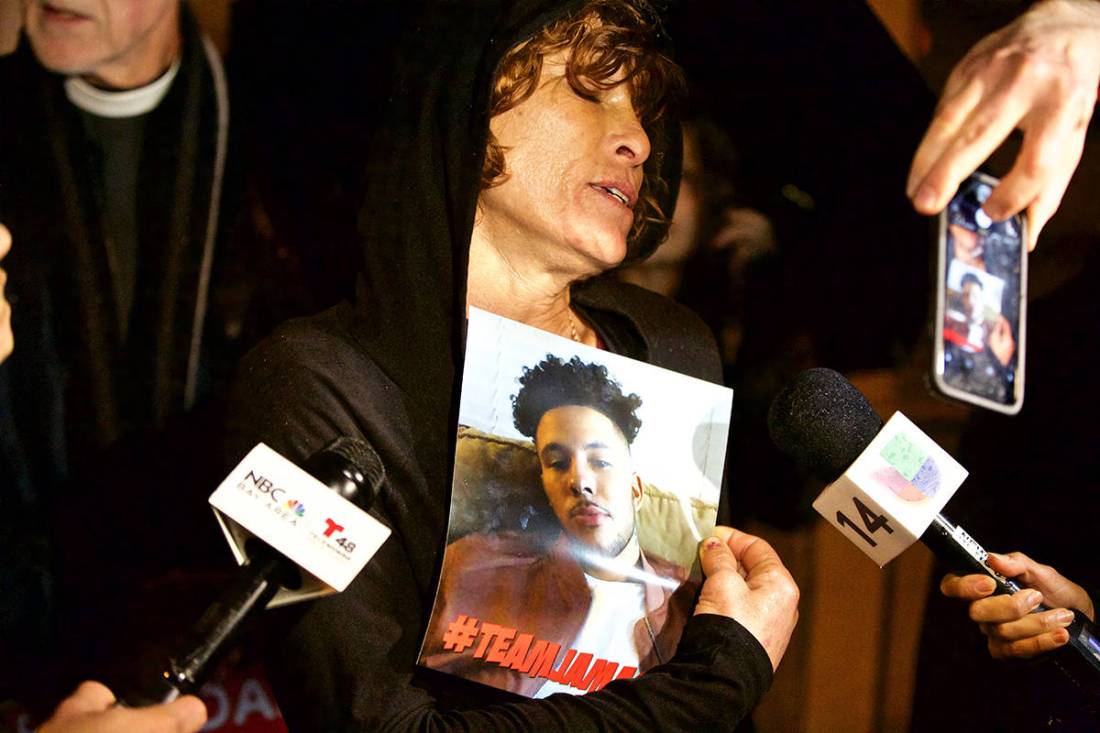
The person who was shot by San Francisco police in the Mission District over the weekend has been identified by his mother as 24-year-old Jamaica Hampton, a formerly homeless man from Sacramento.

Police have yet to announce when they will hold a town hall meeting to release further details about the case to the public. The meetings are typically held within 10 days of a police shooting.

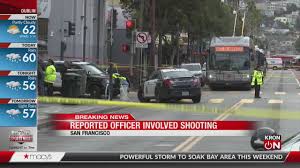
Police shooting Mission II 12.10.2019.jpg

Hampton was shot near 23rd and Capp around 8:34 a.m. Saturday. Police said he matched the description of a suspect in a nearby burglary and attacked two officers with a glass bottle.

His mother, Tana Hampton, told reporters Tuesday evening outside Mission Police Station that she had not spoken to her son in three weeks and questioned why officers had to use lethal force against him.

“It doesn’t make any sense,” his mother said. “He’s not aggressive that way. He has to be provoked. You have to provoke him… He’s not going to put his hands on somebody just because they are standing there.”

Jamaica Hampton remained in critical condition at Zuckerberg San Francisco General Hospital as of Tuesday evening, according to a hospital spokesperson. Advocates say he was shot at eight times and struck three times.

Police have released limited details in the case and have not confirmed the identity of the man who was shot. But the San Francisco Police Officers Association has said the officers were attacked.

One of the officers was hospitalized with injuries and released late Saturday. A witness previously said that one of the officers was bloodied in the confrontation and cut on the face.

Tana Hampton said she has not been allowed to see her son since driving down with family from Sacramento on Tuesday. She questioned why police shot her son when the weapon he allegedly had was a glass bottle.

“Something is very wrong,” she said. “All I know is they did my son wrong and they act like it’s not a crime — it’s a crime.”

A video published online in October by CityTeam San Francisco, a social services organization that offers addiction recovery services, documented Jamaica Hampton’s story.

“Growing up was tough,” Hampton said in the video, dressed in all black with his hair tied into a bun at the crown of his head. “I remember being homeless a lot. It seemed normal at the time, my mom being homeless and dragging us with her.”

Hampton described “growing up in a drug house, all kinds of people in and out of it, and pretty much being raised there.”

Hampton said he entered the foster care system at age 12, where he and his siblings were “split up.”

“It carried over as an adult,” he said, adding that he suffered from anxiety disorder stemming from childhood trauma.

Hampton is candid in the video about struggling with substance use issues, and said he began drinking at age 21 to numb his inner turmoil.

“I was depressed, I tried to kill myself, and I ended up pushing everybody away,” he said. “I ended up becoming homeless, not really knowing how to get out of the situation I was in.”

Not having a father figure in his life, Hampton said there was a void in his life that he tried to fill “with drugs and alcohol.”

But he appeared to have found support to turn his life around with CityTeam and said his goal was to join the organization’s youth mentorship program for foster youth, and eventually become a social worker.

“I want to help the kids that were in my situation, and maybe just try to be a role model for them,” Hampton said. “I could be an example of what not to do — but also an example of how to get back on your feet.”

The incident marked the first on-duty shooting by the San Francisco Police Department since June 2018.

https://www.sfexaminer.com/news/man-shot-by-police-in-mission-district-struggled-with-homelessness-drug-addiction/


Putin calls Chechen murdered in Berlin a ‘bandit.’ Russians deny State involvement

Relations between Germany and Russia have soured after a Georgian citizen of Chechen descent was murdered in broad daylight last August.  

The German government has already expelled two Russian diplomats.  The Russians will reciprocate in kind while denying any State involvement in this apparent political assassination.

Deutsche Welle 12.10.2019

Vladimir Putin has called a Georgian man murdered in Berlin a “bandit,” saying Moscow’s requests to extradite him weren’t heeded. Berlin says there’s evidence Russia is behind the killing, but Putin denied involvement.

Although Russian President Vladimir Putin denied any involvement, he described the murdered man as a “bandit” and killer. He said that Russia’s requests to extradite him had not been heeded.

He added, however, that Moscow was ready to assist in the investigation and “do everything to help our German colleagues.” Putin also denied that there was a diplomatic “crisis” between the two countries.

Chechen Murder II 12.10.2019

Vladimir Putin and Angela Merkel in happier times

In the diplomatic fallout over the murder of a Georgian man in Berlin,  President  Putin threatened to respond in kind to Germany’s move to expel two Russian diplomats.

“There are unwritten laws in such cases: You expelled our diplomats, we expel yours,” Putin said at a press conference on Monday night following talks on the Ukraine conflict.

Germany expelled the Russian Embassy employees last Wednesday over Moscow’s failure to cooperate in the murder investigation. Federal prosecutors said that evidence indicated Russian or Chechen state involvement in the murder.

German Chancellor Angela Merkel said she had raised the issue with Putin during their bilateral talks in Paris, urging Moscow to cooperate.

“I expect that the Russian side will provide us with its information,” Merkel said. “In any case, I think that would be good.”

Read more: Did Russian intelligence hire a criminal to execute a Chechen dissident in Berlin?

Political murders ‘cannot be tolerated’

Bijan Djir-Sarai, foreign policy spokesman for Germany’s business-friendly Free Democrats (FDP), said he expected further clarification from both Russia and Germany — including the source of Berlin’s “suspicion that ultimately led to the expulsion of the two diplomats.”

“Political murders on EU soil cannot be tolerated under any circumstances,” Djir-Sarai said in an interview with DW. “The Russian government must now back up its words with actions to help the chief prosecutor solve this murder.”

Read moreGerman defense minister calls out Russia after Berlin murder

Jan Korte of the socialist Left party praised the government’s handling of the case, but stressed that the German-Russian relationship could do with improvement. He told DW there should be “reasonable cooperation,” especially given Germany’s historical responsibility — a reference to Nazi Germany’s invasion of the Soviet Union during World War II and to the Red Army’s role in defeating Nazi forces.

What is the case?

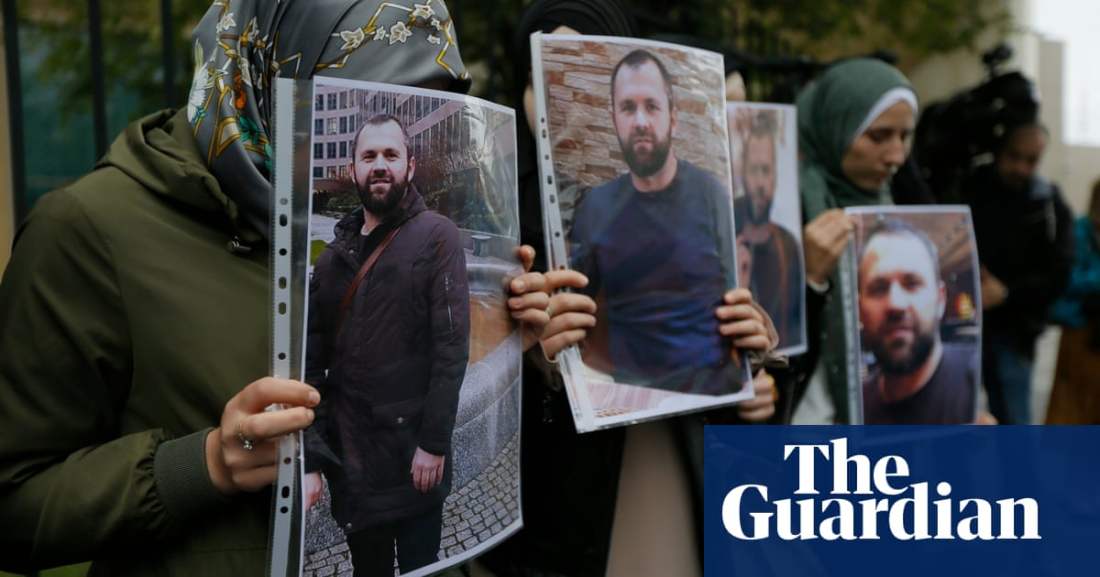
In late August, 40-year-old Zelimkhan Khangoshvili was shot in an “execution-style” killing in Berlin’s Kleiner Tiergarten. The suspect in the case carried out the shooting on a bicycle in broad daylight — shooting the victim in the head and chest. The suspect cycled to the nearby River Spree and tossed the weapon into the water.

Khangoshvili was an asylum-seeker of Chechen descent from Georgia. He fought against the Russians as a separatist during the Second Chechen War from 1999 to 2009. After the war, he reportedly worked in both Ukraine and Georgia against Russian interests.

He applied for asylum in Germany in 2016 following multiple attempts on his life in Georgia. However, his asylum application was denied and he was slated for deportation.

On Wednesday, German federal prosecutors said that there was “sufficient evidence” to indicate that the man’s murder may have been carried out on Russia’s behalf. The expulsions of the diplomats were announced the same day.

Russia condemned the move as “unfriendly” and said that suspicions of Russian state involvement were “baseless.”

https://www.dw.com/en/vladimir-putin-calls-georgian-murdered-in-berlin-a-bandit/a-51602615

Susan Rice’s memoir prompts nostalgia for the Obama years

As America descends on a daily basis into the Dystopian trauma brought upon us by the 63 million voters who put the train wreck of a human into the White House it is worth the time to remember what was before pandemonium became the norm.

Watching the Impeachment hearings and the reprehensible thug like behavior of the Republican enablers is more than depressing. It is a shattering commentary on what has become of America

Washington Post – David Ignatius 11.28.2019

Reading Susan Rice’s new memoir, “Tough Love,” is a reminder of two things: what a remarkably gifted, subtle but maddeningly distant man President Barack Obama was; and how people such as Rice who served him endured ceaseless public attacks in a country that was already on the ragged edge, though we didn’t yet know it.


Washington memoirs are most valuable for the parts that aren’t about what the author did at the office. That’s especially true of this account by the former national security adviser. The riveting passages are where Rice tells the private story that was hidden: her parents’ brutal divorce, her mother’s death, her children’s struggles with their mother’s public vilification.


Good memoirs always have a quality the Germans define as a bildungsroman, a novel of the principal character’s education in the world. That’s true with Rice’s tale: She was an African American who triumphed in the elite world of prep schools, Ivy League colleges and Rhodes scholarships. She embodied the intellect and ambition these institutions aspired to produce, even as she masked a shattered family where her parents “fought ugly and often,” she writes, and her home life was “like a civil war battlefield.”

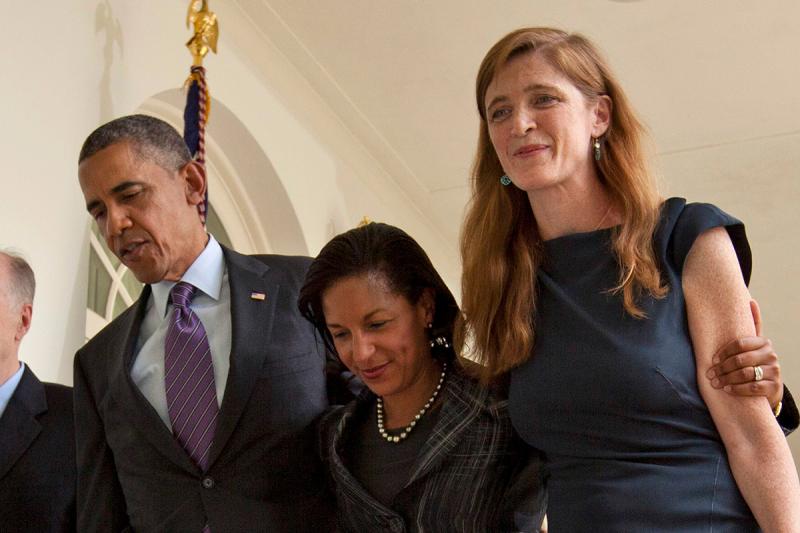
President Obama, Susan Rice and UN Ambassador Samantha Power


David Brooks, the New York Times columnist, describes the distinction between “résumé virtues,” the tokens of meritocratic success, and “eulogy virtues” that truly define someone’s character. Rice’s story and, indeed, Obama’s combine both in a compelling but sometimes unstable mix.


For all her privilege, Rice was famously pugnacious. In 1999, as a young assistant secretary of state in Bill Clinton’s administration, she gave the finger, literally, to foreign policy mandarin Richard Holbrooke, in a roomful of diplomats. In 2008, campaigning as a surrogate for Obama, she threw roundhouse rhetorical punches at his rival, Sen. John McCain (creating a feud about which she repeatedly expresses regret).


But she learned from these mistakes, partly after she began taking some heavy punches herself. She quotes (approvingly) the withering critique offered then by her Clinton administration colleague, Ambassador Howard Wolpe: “You are overly directive and intimidate others so much that you quell dissent and stifle contrary advice.”

People who’ve worked with Rice in recent years would say she had to keep relearning that lesson of humility, and she’s still one of the few senior foreign-policy officials who regularly drops the f-bomb. Obama advised her at one point in the White House that her problem was that she lacked a poker face. That’s a telling criticism from Obama, who could be Mr. Cool to a fault.


Rice was battered during what should have been the zenith of her career because of the Benghazi “scandal,” which, as she retells it, seems an even more bizarre piece of Republican character assassination than it did at the time. She went on five network Sunday shows to explain the tragedy that had happened there, using “talking points” that had been prepared by the CIA, and was so intensely demonized that her mother and daughter both were badly traumatized.


The Benghazi fallout changed Rice’s life, probably for the better. She withdrew from consideration as secretary of state in Obama’s second term and instead became national security adviser. And she learned to subordinate her own public persona. She describes her role overseeing the National Security Council staff as playing “point guard,” a player that “is rarely the showboat or the high scorer . . . but is essential to the cohesion and efficacy of the team.”

Rice acknowledges that the Obama administration’s foreign policy record was “mixed.” The flaws were perhaps most evident in the inability to find a policy that would avert the slaughter in Syria. “My heart and my conscience will forever ache over Syria,” she writes. The larger problem, she explains, is that “we suffered from a mismatch between our stated objectives and the means we were prepared to employ to achieve them — in Libya, Syria, Ukraine and, arguably, Afghanistan.” She has that right.


Behind Rice is the extraordinary figure of Obama, whom she acknowledges was “consistently the smartest guy in the room” whenever the NSC met. It’s impossible not to feel nostalgic for his intelligence and personal reticence these days, as the country is buffeted by a president whose personal qualities are a reverse image of his predecessor.

Obama, lean, austere, almost professorial in his demeanor, was a man who despised flattery and liked to pass the time playing cards, watching sports on television and thinking about how best to make a difference in the world. How far away that moment seems this Thanksgiving week.

Climate change: Majority of Germans support ditching Christmas lights

The Germans have a good idea on how to save energy during the Holiday season.

Next. Eliminate Christmas tress as an another way to help the environment. Think of all the forests which would beautify the plant.

Deutsche Welle 12.8.2019

As part of efforts to combat climate change, a majority of Germans say they’re in favor of scaling down or completely abandoning their Christmas lights this year, according to a new survey.

A majority of Germans say they would consider scaling down their Christmas lights to protect the climate, a survey released on Sunday said. A total of 57% of those surveyed said they would reduce Christmas lighting or even do without it in the future, according to the survey conducted by YouGov on behalf of the German news agency DPA.  

Of the respondents, 11% said they would make do without any lights this year due to climate concerns, while 10% said they would do so in the future. But 35% said turning off the lights was not an option for them.

Xmas German II 12.9.2019.jpg

Read more: Don’t buy a Christmas tree, plant one

Opinion is split on whether there should be fewer lights on buildings and in the streets in general, with 44% both for and against the idea. Having lights up during the festive season is appreciated by a large majority of 79% in Germany. Almost seven out of 10 people surveyed plan to decorate their homes with electric Christmas lights this year.

Environmental concerns

Christmas lights are a common feature during the festival season every year, with the lights wrapped around homes, streets and trees. But scientists have warned that the lighting does have an environmental cost.

Combating climate change has been high on the global agenda, thanks in part to the activism of Swedish environmental campaigner Greta Thunberg.

Read more: ‘Total economic transformation’ — getting from here to there on climate change

Currently, representatives from all over the world are meeting in Madrid for the United Nations COP25 climate conference to discuss measures to decrease carbon emissions as part of the 2015 Paris Agreement.

Unless global greenhouse gas emissions fall by 7.6% every year, the world will fail to meet the 1.5°C temperature goal of the Paris Agreement, a report from the UN Environment Program warned in November.

https://www.dw.com/en/climate-change-majority-of-germans-support-ditching-christmas-lights/a-51576565

Another San Francisco police shooting. Eyewitness to Mission District incident

San Francisco Police shot a civilian in the City’s Mission District on Saturday morning. This is the first SFPD shooting since June 2018.

The District Attorney’s office is currently investigating several shootings by San Francisco officers. To date none have been charged with a crime.

District Attorney elect Chesa Boudin, who has vowed to closely monitor SFPD, will assume responsibility for prosecution of police involved shootings when he takes office next month.

Mission Local 12.7.2019

Mission Local’s Julian Mark is on the scene at 23rd and Mission, where, around 8:30 a.m., police shot a man multiple times — the first police shooting since June of last year.

The man who police shot is in critical condition, according to Brent Andrew, a San Francisco General Hospital spokesman. One San Francisco Police officer, he said, was also present at the hospital, but Andrew could not state his condition.

An eyewitness who said he’s working a construction job not far from the site told Mark he witnessed the entire event. The witness, who declined to be identified, said that he observed a “clearly” intoxicated man from his truck at around 8:30 in the morning. Not long thereafter, a San Francisco Police Department SUV rolled up.

The witness says two officers chased the man about the intersection on foot. He said the officers pepper-sprayed the man and may have applied other less-lethal devices as well.

The man did not appear to be armed; the witness recalled “his arms waving around.” Some manner of physical interaction ensued. During this time, while the man was on the ground, the witness says he was shot by both of the officers. The witness counted eight to 10 shots.

Following the shooting, the witness said an officer pointed a gun in his direction, and he ducked. He described the shooting as “a broad daylight execution.”

Mark is on the scene and will continue reporting; Mission is blocked between 22nd and 24th, and the Mission and 23rd intersection is sealed.

Mission District Shooting II 12.7.2019

Police spokesman Officer Robert Rueca gave the following synopsis on the scene: At 8:34 a.m. officers responded to a call of a hot prowl burglary in the area of 23rd and Capp Streets. They encountered a suspect who matched the description. When they encountered the suspect, he assaulted an officer with a weapon. An officer-involved-shooting occurred. One suspect and one officer were transported to a hospital and are in unknown medical condition. 

Update 11:29 a.m.

Lisa Ruth, the store manager at Fallas Discount Stores, previously Factory 2-U, said that she was talking with the store’s security guard just before 9 a.m. when they heard “eight pops.”

They turned to look and went to the intersection of 23rd and Mission streets to see a man lying on the ground. Officers had taken his clothes off and a swarm of officers was trying to resuscitate him. She did not see a weapon nearby.

However, one of the officers nearby appeared to have a broken nose, a bloody face and bruise marks around his neck, she said.

Ruth said she recognized two officers – one a light short Latino and the other an African American – because they had patrolled in the area and had helped her out in the past. They’re “young kids,” she said.

“Honestly it’s the Mission,” she said. “It’s sad this happened but there are people who are on the street who try and hurt me all the time. “

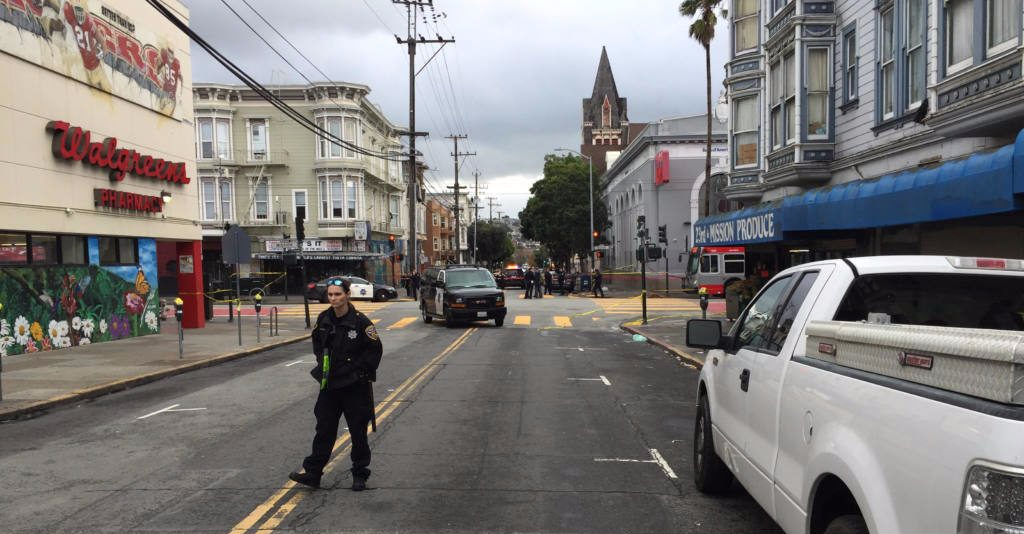
Mission District Shooting I 12.7.2019

Another source who asked not to be identified and works nearby at Smile BBQ at 22nd and Mission streets said that five minutes before the shooting, a man had come by and smashed their window. It’s unclear if the two incidents are related.

The last police shooting in San Francisco occurred in June,2018 in North Beach. So far, no officers have been charged in police shootings, but District Attorney-elect Chesa Boudin has promised to take a harder look at each case. The DA’s office, which right now is headed up by Interim District Attorney Suzy Loftus, is for the first time ever the lead investigator in five concurrent investigations — also by the SFPD’s homicide detectives, the SFPD’s internal affairs division, the Department of Police Accountability, and the San Francisco Medical Examiner.

As has become standard practice, the SFPD will hold a town hall meeting within 10 days of Saturday’s incident to describe their version of the events and the preliminary results of the investigations. In the past, police have shown officers’ body-worn camera footage at town hall meetings.

https://missionlocal.org/2019/12/eyewitness-describes-troubling-police-shooting-at-23rd-and-mission/

Police unleashed. Innocent Petaluma man died after sheriff’s carotid choke-hold

For all the talk about Police reform, there is still a pathetic lack of restraints on behavior by cops.  The Courts, the media and the public at large have bought into the benevolent attitudes toward law enforcement.

 The death  of an innocent man by local Sheriffs in Sonoma County is another horrific example of police abuse and misconduct.

San Francisco Chronicle 12.6.2019

A 52-year-old man who was mistaken for a stolen car suspect and died after a Sonoma County sheriff’s deputy used a neck-hold to cut off blood to his brain, had difficulty walking, talking and breathing due to multiple health problems, friends and family told The Chronicle on Tuesday.

David Glen Ward, of Petaluma, died last Wednesday after two sheriff’s deputies and two Sebastopol police officers mistook him for a vehicle thief and chased him in his green Honda Civic, which Ward had reported stolen three days earlier.

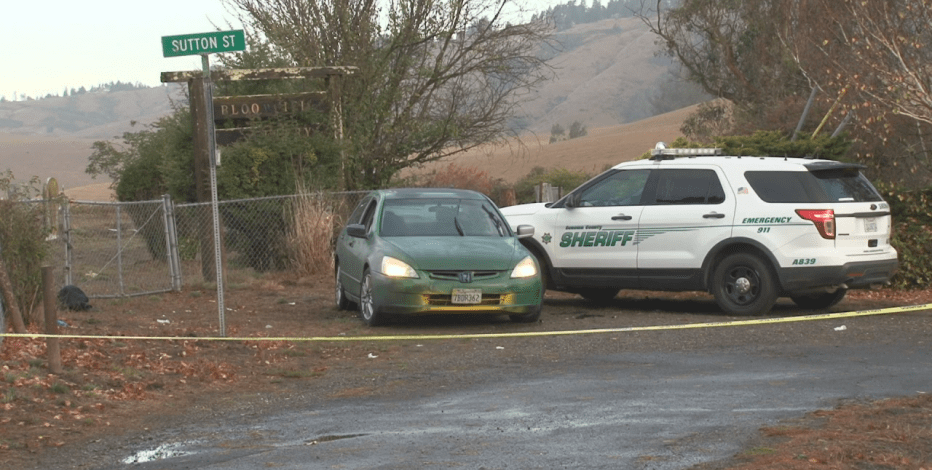
sonoma-cop-killing-i-12.6.2019.jpg

Deputies and officers surrounded the car after a seven-minute, 70-mph chase ended on a dead-end road south of Sebastopol and a struggle ensued to get Ward out of the car, according to the Santa Rosa Police Department, which is conducting an investigation into his death.

One deputy deployed a Taser and another used what is known as a carotid restraint or carotid choke-hold on Ward, who was allegedly resisting. Ward became unresponsive as he was removed from the vehicle, officials said. He later died at the hospital.

On Tuesday, a spokesman for Santa Rosa police said officials are investigating the timeline of the struggle, including how close together the Taser and carotid hold were used.

“It’s kind of tough to say,” Lt. Dan Marincik said. “They occurred very close to each other.”

People close to Ward expressed doubts Tuesday that he would have put up much resistance based on his limited physical abilities.


Catherine Aguilera, 63, said her half-brother was disabled from a crash involving a drunk driver roughly 20 years ago. In that accident, Ward was driving a motorcycle in the Petaluma area when he was struck and thrown “quite a distance,” said Aguilera, a resident of Monroe, Wash.

Ward suffered head and back injuries, rendering him dependent on a caretaker. He moved in with his father at a rural property on Mill Street in Bloomfield, an unincorporated area in Sonoma County. After their father’s death four years ago, Aguilera said, Ward became depressed, lonely and isolated.

He welcomed the “down and out” into his home, she said, perhaps to his detriment.

“He had some connections with people in the community that didn’t have his best interest in mind,” Aguilera said.

Rene Gutierrez, who lived in a cottage next to Ward and had been helping him cope with various physical ailments for about a year, said he introduced Ward to a man he identified as “D.” Ward let “D” stay at the house, Gutierrez said.

“He schmoozed his way right in,” he said. “Then he brought his girlfriend. That’s when the trouble started.”

On Nov. 24, Gutierrez said he heard the sounds of a fight coming from Ward’s house. He entered and saw “D” beating Ward with a handgun. The couple fled in Ward’s car, Gutierrez said, and Ward reported it stolen. Authorities confirmed they received a stolen car report regarding the Honda Civic three days before Thanksgiving. The suspect was said to be armed.

Two days after the car was stolen, Gutierrez said, a mutual acquaintance told Ward that the car was in Santa Rosa and drove him there to retrieve it. Ward was driving home when Sebastopol police and sheriff’s deputies initiated the stop on his vehicle, Aguilera said.

Ward was not using an oxygen tank when officers approached him, according to police. It remains unclear whether his oxygen tank was in the car. Authorities said Ward refused to get out of the car and asked deputies why they were “harassing” him and stated he was the “victim” in the situation, Lt. Marincik said.

Beyond that, Marincik said, “communication was very minimal.”

Deputies tried to pull Ward out of the car after he rolled down his window and bit the officers, Marincik said.

Sgt. Juan Valencia, of the Sheriff’s Office, said there is body camera video of the chase and struggle, which will be released within 45 days of the incident.

The use of the carotid restraint, in which an officer squeezes a subject’s carotid arteries and cuts off blood to the brain, is controversial and has been banned by some law enforcement agencies. San Francisco prohibited the hold in 2016, but Sonoma County sheriff’s deputies are allowed to use it.

According to the office’s use-of-force policy, the hold “may be effective in restraining a violent or combative individual,” but it cautions that the move can cause injury and should be limited to specific circumstances.

“It’s used — I shouldn’t say commonly,” Valencia said. “It’s one of the tools that we have for taking people safely into custody.”

Aguilera said she has read reports of what happened and puzzled over the fact that four law enforcement officers swarmed the vehicle of her brother, who “wasn’t a big, strong, healthy guy.”

“The whole thing just raises thorny questions, and it just is so very violent what happened,” Aguilera said. “I mean, I would be afraid to get out of the car, too. It sounds frightening, and if he was having problems breathing, I could see where that would contribute to him not complying.”

The two sheriff’s deputies who were at the scene when the pursuit ended were a part of a line-of-duty shooting in 2017, and one of the police officers was a defendant in a civil rights lawsuit, according to court records.

Sonoma County sheriff’s Deputy Charlie Blount, who has been with the force since Feb. 7, 2000, and Deputy Jason Little, who has been with the office since Jan. 28, 2002, were investigated in 2017 for shooting at a man who had reportedly assaulted someone and had an outstanding warrant. The man suffered non-life-threatening injuries, and both deputies were cleared of criminal wrongdoing.

Another officer who was at the scene last Wednesday, Andrew Bauer, of the Sebastopol Police Department, tried to get a 58-year-old man out of his home in November 2014 and “became aggressive” when the man refused, grabbing his right arm and twisting it behind his back, according to a lawsuit.

Bauer allegedly slammed the man’s face into the arm of a recliner, breaking the man’s glasses and slicing the man’s nose. The man was never told why the officers were at his home or that he was under arrest, according to the complaint. A $65,000 settlement with the man was reached in September 2015, according to court records.

All four of the deputies and officers in the incident involving Ward have been placed on administrative leave as Santa Rosa police investigate.


https://www.sfchronicle.com/crime/article/Petaluma-man-who-died-after-sheriff-s-14879676.php#photo-18699803