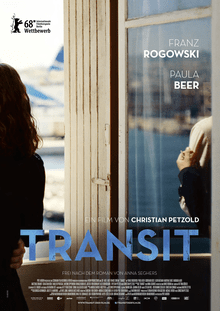
“Transit,” the book by Anna Seghers and the film, has been the subject of earlier Blog posts. The film is, finally, opening in San Francisco at the Clay Theater.
SF Chronicle – Walter Addiego 3.19.2019
Christian Petzold’s “Transit” takes a huge risk and mostly pulls it off. A German, and one of today’s premier European filmmakers, Petzold gambles on a simple but radical alteration of his source material that’s certain to infuriate some viewers.
That source is an acclaimed 1944 modernist novel, “Transit Visa” by Anna Seghers, a German Jew and communist who in 1940 fled Paris after the Nazi occupation. It’s a story about the crushing imperative to flee from murderous ideologies and the mixture of desperation and tedium suffered by those thwarted in the attempt.
Like the novel, Petzold’s film takes place in Paris and Marseilles as the Germans are spreading terror through France. But “Transit” doesn’t take place 80 years ago — it’s set in something that looks more like the present, a present where shrieking police sirens are a constant and house-to-house searches take place to find and eradicate enemies of the state.
A young German man, Georg (riveting Franz Rogowski), is focused on getting out of Paris one step ahead of the invading Germans, having already experienced their brutality. He is persuaded to accompany a famous communist writer, carrying his latest manuscript, to Marseilles, where the author will meet up with his wife and flee to Mexico. The writer never even makes it to Marseilles.
Mistaken for the writer, Georg realizes that an impersonation might be his ticket out of France. Of course, complications arise. He encounters the writer’s wife (Paula Beer), who had told her husband she was leaving him. She has taken up with a doctor (Godehard Giese), who is almost wounded by his love for her. Georg falls for her himself, which raises more difficulties.
There are ample opportunities for self-sacrifice, and betrayals as well. Characters collapse in the face of fear, or collaborate. Our hero needs to flee but can’t or won’t, and time is growing short as the Germans close in.
“Transit” aims to invoke dread and a suffocating atmosphere. It trusts viewers to make connections. Overall, the filmmaking is exceptional. Still, I have qualms about the director’s choice to use occasional voice-over narration, and there’s a digression involving Georg’s relationship with a lonely Arab boy and his deaf mother that seems unnecessary.
But Petzold, whose “Barbara” (2012) won the best director award at the Berlin Film Festival, has no difficulty creating a sense of existential woe. “Transit” has a hint of science fiction, and more than a hint of Kafka. And despite the story’s link to World War II, it’s clear that Petzold wants it to resonate with today’s immigration problems.
It’s a demanding film, but gives a lot in return.